There is no idea in wellness more marketed right now than the gut. Probiotics, prebiotics, postbiotics, ‘gut resets’, ‘leaky gut’ protocols, powders to ‘rebuild your microbiome’ — an entire industry has assembled around a genuine scientific revolution, and it is mostly running ahead of the evidence it claims to stand on. Both halves of that sentence are true, and holding them together is the whole task. The microbiome is a real organ, with real mechanisms that can be measured. And the confident claims made in its name are, with a few important exceptions, not yet things anyone has actually shown.
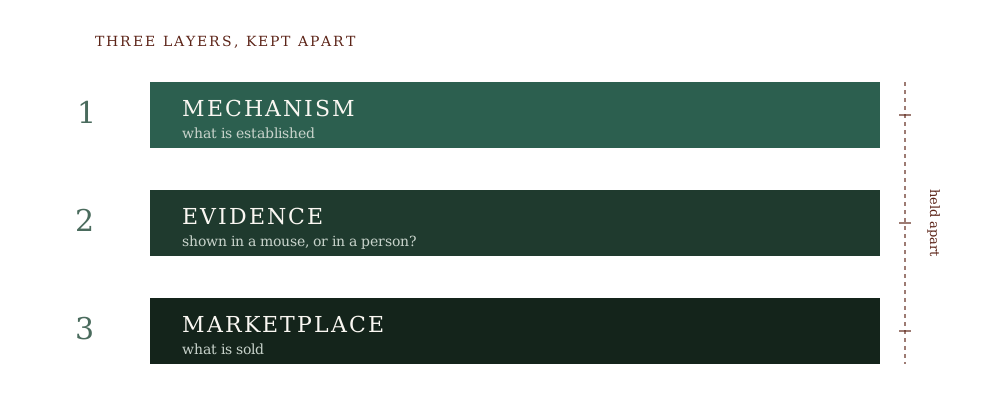
I am going to build this essay in three layers and keep them apart, because the bleeding between them is exactly where the trouble starts. The first layer is what is genuinely established about the mechanism. The second is how much of it has actually been demonstrated in humans rather than in mice. The third is the marketplace, measured against the first two. Most of what goes wrong in this subject is a claim from the marketplace wearing the authority of the mechanism, or a finding from a mouse wearing the clothes of a human result. Kept in their own layers, the parts are honest. Stacked carelessly, they become the pitch.
The organ, established
Start with what is not in doubt, because it is genuinely remarkable and it is the ground the rest stands on.
The bacteria in your large intestine ferment the dietary fibre you cannot digest, and one of the things they produce is butyrate, a short-chain fatty acid. Butyrate turns out to be the preferred fuel of the cells lining your colon — they run on it in preference to glucose. This was shown, in human tissue, more than forty years ago. So the relationship is not decorative: the lining of part of your gut is, in a real sense, fed by its bacteria. That is already enough to call the microbiome an organ rather than a passenger.
It does more than feed the wall. Short-chain fatty acids, butyrate chief among them, act as signalling molecules to the immune system. In a set of landmark mouse studies published in 2013, they were shown to drive the development of regulatory T cells in the colon — the immune cells that keep inflammation in check. And when the gut barrier is compromised, fragments of bacterial cell wall called lipopolysaccharide can cross into the circulation and provoke a low-grade inflammatory state that has been tied, in animal models and human association, to insulin resistance. This last phenomenon has a name in the literature — metabolic endotoxemia — and it matters greatly for what follows, because it is the real, measurable thing that the marketing term “leaky gut” gestures at and then inflates beyond recognition.
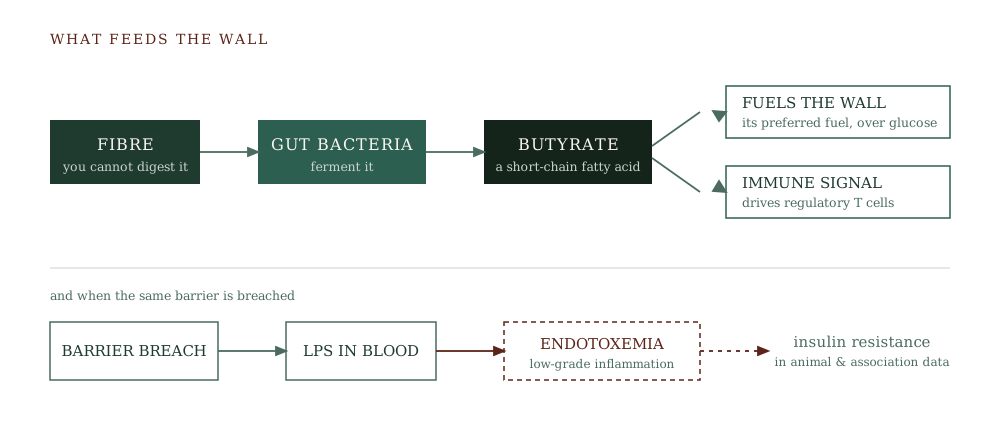
Notice the honest caveat I have to attach here, and will keep attaching: the immune-signalling and the endotoxemia work is largely built on animal models and human association. The mechanism is real and characterised. That it operates in a given human being, at a scale that explains that person’s disease, is a further claim — and a weaker one than the mechanism itself.
What we can actually claim
Here is the uncomfortable centre of the subject. The strength of the microbiome evidence falls sharply the moment you move from “this mechanism exists” to “changing it changes an outcome in a person.”
The strongest causal evidence comes from germ-free mice — animals raised with no bacteria at all, into which a defined microbiome can be introduced and the effect watched. Transfer the gut bacteria of an obese mouse into a lean germ-free one and it gains more body fat than a mouse given a lean donor’s bacteria; this is a clean, dramatic demonstration that the microbiome can be a cause and not merely a correlate. But it is a demonstration in a mouse, under conditions no human ever occupies, and the leap from there to your body is exactly the leap the marketing makes without announcing it. In humans, the overwhelming majority of what we have is association: people with this disease tend to have that microbial pattern. Association cannot tell you which way the arrow points — whether the pattern caused the disease, the disease caused the pattern, or a third thing caused both.
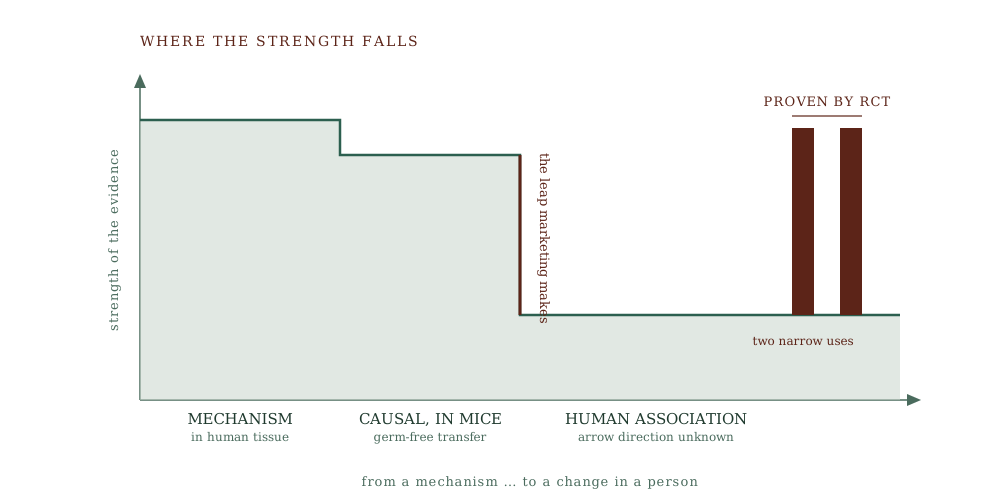
There are, at the time of writing, only a couple of microbiome interventions proven in humans by randomised trial to change a hard clinical outcome, and they are worth stating precisely, because they are at once the proof that this organ is real and the marker of how narrow the proven ground still is. The clearest is faecal microbiota transplant — transferring an entire stool microbiome from a healthy donor — which cures recurrent Clostridioides difficile infection, a severe and often relapsing gut infection, far better than the standard antibiotic. The trial that established this was stopped early because the transplant was so clearly superior that continuing to give the comparison treatment was hard to justify. That result is now the basis of approved therapies. There is, arguably, one more: in premature infants, specific probiotic strains reduce necrotising enterocolitis — a hard, often fatal gut catastrophe of the newborn — in randomised trials, and lower deaths with it. Notice what the two proven uses share. Both are narrow, specific, gut-localised, and often life-threatening — a relapsing infection in one, a preterm emergency in the other. Neither is “gut health,” or mood, or metabolism, or immunity in general. The organ is real. The proven ground is a couple of small, high-stakes fields — not the meadow the marketing promises.
The marketplace, measured against that
Now hold the industry up against those two layers.
Take the ordinary probiotic — a capsule of selected bacterial strains, sold to “restore” or “rebuild” your microbiome. When researchers actually looked at whether the bacteria in such products take up residence in the human gut, they found that colonisation is highly personal and often merely transient: in many people the strains pass through and leave, establishing nothing, and whether they colonise at all depends on the individual’s existing microbiome in ways a label cannot predict. This does not make every probiotic useless for every purpose — there are specific strains with specific, modest, tested effects in specific conditions. It does mean that the generic instruction to “take a probiotic” to “improve your gut health” is selling a permanence and a generality the evidence does not support.
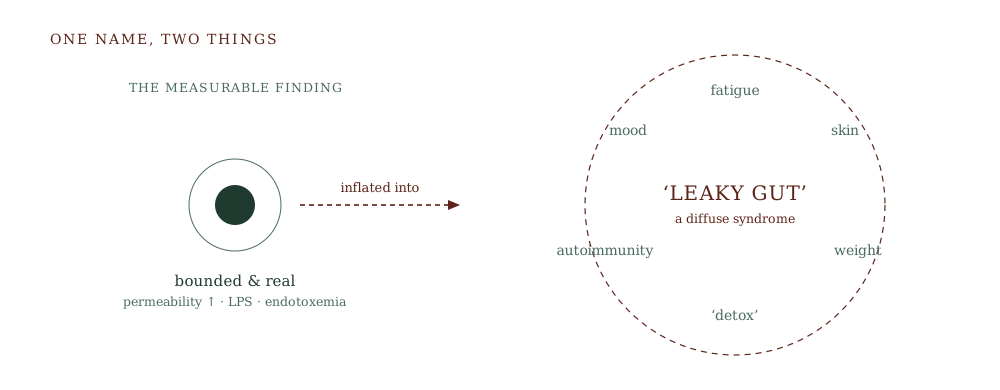
“Leaky gut” is the sharper case, because it takes the one genuinely measurable thing in this section and stretches it out of shape. There is a real phenomenon of increased intestinal permeability and bacterial fragments entering the circulation — the metabolic endotoxemia above. What the marketing does is take that real, bounded finding and inflate it into a diffuse syndrome said to cause almost anything — fatigue, mood, skin, autoimmunity, weight — and then sell you the supplement to “seal” it. The measurable phenomenon and the marketing syndrome share a name and almost nothing else. And “detox” belongs here too, applied to the gut as it is applied to the liver: there is no cleanse that has been shown to do for your intestine what the intestine is not already doing for itself.
The honest lever
If the mechanism is real but the proven interventions are almost bare, what does a serious clinician actually offer? The answer is deflating, which is how you know it is not a sales pitch.
The single best-supported way to influence your microbiome is to feed it — specifically, to eat a wide diversity of whole plants and enough fermentable fibre that the bacteria which produce butyrate and its cousins have something to ferment. Fibre here means fibre from a range of actual plants, not a prebiotic powder, which is the same hype in a different tub. A more diverse plant intake is associated with a more diverse microbiome, and fibre is the raw material for the very short-chain fatty acids whose mechanism opened this essay. This is unglamorous, it is cheap, there is nothing proprietary to sell — not a strain, not a scoop — and it is the intervention with the most support behind it. That combination — most evidence, least profit — is not a coincidence. It is what honest advice in a hype-saturated field tends to look like.
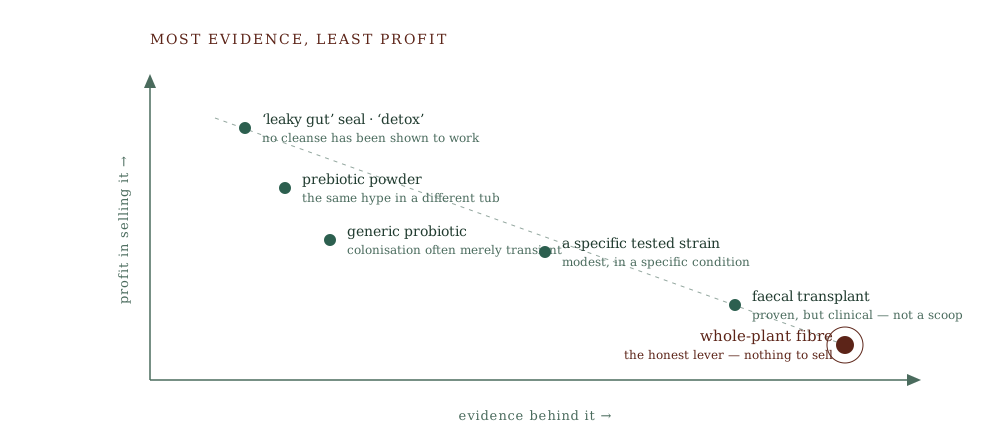
I do not tell patients I can rebuild their microbiome, because no one can yet do that in a controlled way and mean it. I tell them we can feed the one they have, and that this is worth doing on the evidence, and that most of what is sold beyond it is running ahead of what anyone has shown.
What would change my mind
The position I have taken here is that the microbiome is a real organ whose proven human interventions are, so far, almost limited to one. That is a claim about the current state of evidence, and it is the kind of claim that should move as the evidence moves.
If well-designed randomised trials showed that a defined probiotic or a microbiome-directed therapy durably changed a hard outcome — not a stool test, not a self-reported symptom, but a measured clinical endpoint — in a common chronic disease, then the proven ground would widen and I would widen my claims with it. There are trials of faecal transplant in metabolic and inflammatory conditions underway, and some early signals; if they replicate at scale, this essay’s caution about a couple of narrow fields will need rewriting, and I will rewrite it. Equally, if the fibre-and-diversity lever failed to hold up — if larger studies found that feeding the microbiome did not reliably do anything measurable — then even the deflating advice I do give would need to retreat. Both are testable. Neither has yet turned. Until one does, the honest map is: real organ, characterised mechanism, one proven therapy, and a feeding strategy with reasonable support — surrounded by a marketplace selling the certainty that all of that is missing.
A closing argument
The gut microbiome is the best current example of a problem that runs through this entire field: a real scientific advance and the industry that rushes to monetise it are not the same thing, and the second routinely borrows the authority of the first. The organ is real. The mechanisms are real. The few proven therapies are real and remarkable. And almost everything past that edge — the resets, the rebuilds, the seals, the generic probiotic sold as a cure for a syndrome — is running on the credibility of the science while outstripping its evidence.
The discipline is simply to hold the layers apart: to say “mechanism” when we mean mechanism, “mouse” when we mean mouse, “proven” only when something is, and “sold” for everything else. Do that, and the microbiome stops being a marketing word and goes back to being what it actually is — one of the most interesting organs in the body, understood well enough to respect and not yet well enough to sell you certainty about. Feed it. Be sceptical of anyone promising to rebuild it. And watch the evidence, because on this subject it is still moving, and the honest position moves with it.