If you have type 2 diabetes, you were probably handed a script on the day you were diagnosed — not only a prescription, but a script in the theatrical sense: the lines the rest of the story was expected to follow. Here is your metformin. The condition is progressive. We will manage it. Over the years the doses climb, other drugs are added, and for many people insulin eventually joins them. That arc was, for a long time, the most honest thing medicine could offer. What you were most likely not told is that for a definable group of people the arc is not the only one — that type 2 diabetes can be put into remission, and that the mechanism is now understood well enough to have a name.
This is the essay most easily misread, so I am going to write it against that risk. “Type 2 diabetes can be reversed” is the exact sentence a supplement seller prints above a photograph of a smoothie — and, said precisely, in a bounded and evidenced sense, it is also true. The distance between those two uses is the whole subject. So I am going to lead with the limits rather than save them for the end, and I am going to use the word the researchers themselves settled on. Not cure. Not reversal, even. Remission — a defined clinical state, entered by a definable group of people, held only as long as the conditions that produced it are held. Everything worth saying here lives inside those boundaries. Said carelessly, outside them, it becomes one more piece of the noise I have spent my career arguing against.

The script, and the assumption inside it
The manage-for-life model is not a mistake. It is a reasonable response to a real observation: left alone, type 2 diabetes usually does get worse. Blood glucose that was controlled on one drug stops being controlled; a second agent goes on; then a third; then, often, insulin. Watch this happen across enough patients and a conclusion forms — that the disease is a one-way process of decline, that the pancreas is progressively and permanently failing, and that the clinician’s job is to stay a step behind the deterioration with escalating medication. The whole architecture of routine diabetes care is built on that conclusion.
The conclusion contains an assumption, and the assumption is the thing worth examining. It assumes the deterioration is the disease revealing its true nature, rather than the disease continuing to be fed. It treats the failing pancreas as a clock running down. But a clock running down and a clock being actively wound backwards look identical if you only ever measure it going in one direction. For thirty years almost no one ran the experiment in the other direction. When someone finally did, the assumption did not survive.
What the pancreas was actually doing
The person who ran it was Roy Taylor, a professor of medicine at Newcastle University, and the framework he built is called the twin-cycle hypothesis, first set out in 2008. Its claim is mechanical and testable: type 2 diabetes, in most people who have it, is driven by fat — specifically, more fat accumulating inside the liver and the pancreas than that individual’s body can tolerate. Liver fat drives up glucose output and worsens the body’s response to insulin; fat inside the pancreas impairs the beta cells that release insulin in the first place. The two organs push on each other in a self-reinforcing loop. The beta cells, on this account, are not dead. They are dedifferentiated — switched off, buried in fat, not destroyed.
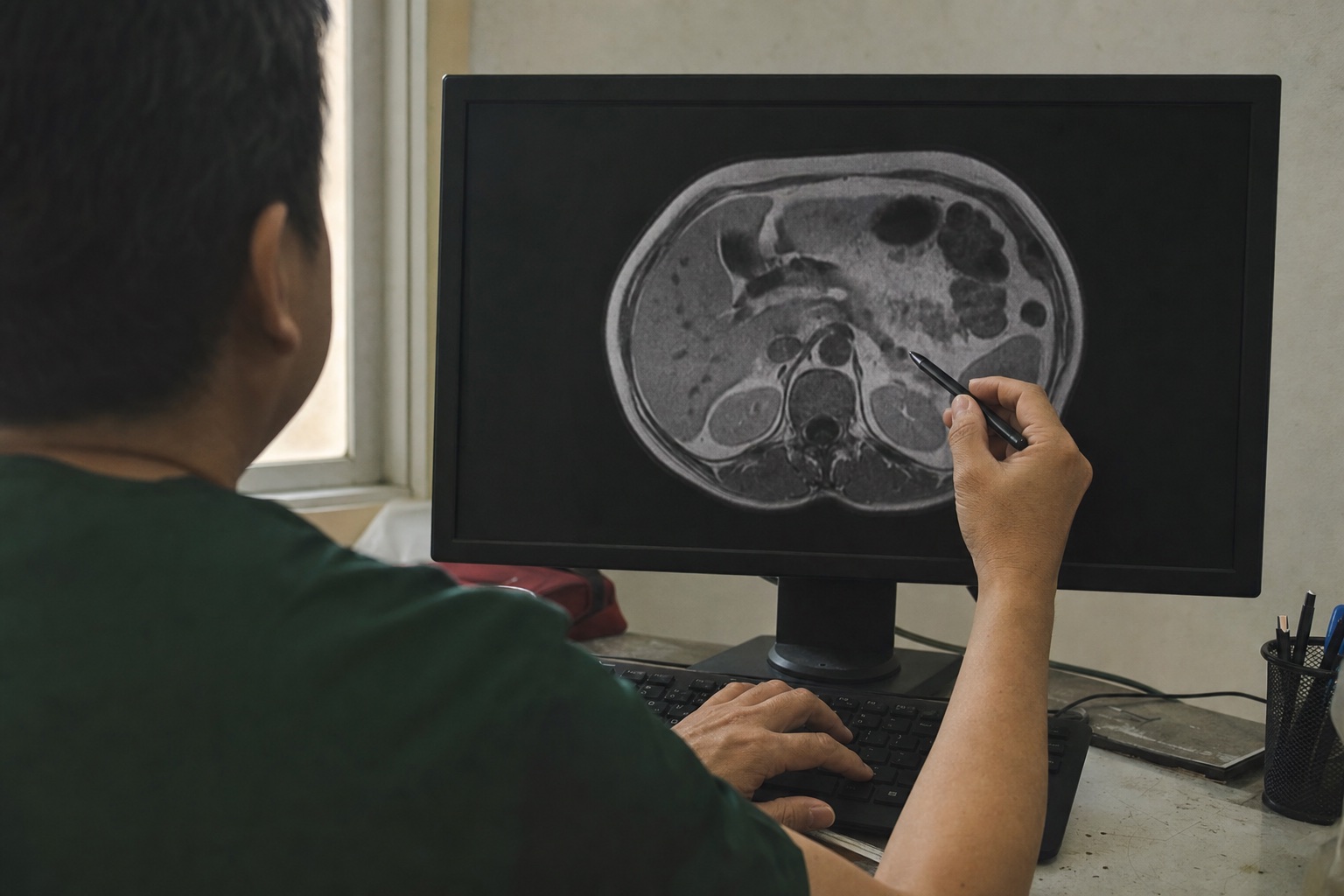
If that is true, then removing the fat should switch them back on. Taylor’s group tested exactly this in a study called Counterpoint, published in Diabetologia in 2011. They took people with type 2 diabetes and put them on a very-low-calorie diet — around six hundred calories a day for eight weeks. The results were not subtle. Fasting blood glucose returned to normal within seven days, well before most of the weight was gone, as liver fat fell. Over the eight weeks, as fat drained out of the pancreas, the first-phase insulin response — the fast, early burst of insulin that is one of the earliest things lost in type 2 diabetes, and that the manage-for-life model had assumed was gone for good — came back. The organ that was supposed to be running down had been wound most of the way backwards. Not in everyone, and not permanently guaranteed. But it happened, it was measured, and it demanded a larger question. If the mechanism could be reversed under laboratory conditions, could that reversal be achieved in ordinary people, in ordinary clinical care, and held — as durable remission?
The trial that changed the question
That question is what the DiRECT trial was built to answer, and it is the single most important piece of evidence in this essay. DiRECT — the Diabetes Remission Clinical Trial — was led by Taylor together with Michael Lean of Glasgow, and its results were published in The Lancet in 2018. It was not a laboratory study. It was run in ordinary primary-care practices, by ordinary practice nurses, in people with type 2 diabetes of up to six years’ duration. The intervention was a structured programme: a period of total diet replacement using a low-calorie formula, then a carefully supported reintroduction of ordinary food, then long-term help to keep the weight off. Crucially, the participants’ diabetes medications were stopped at the start, not added to.

At twelve months, forty-six per cent of the intervention group were in remission — off all diabetes medication with a blood glucose in the non-diabetic range — against four per cent in the control group receiving usual care. That figure alone would matter. But the more instructive number is the one underneath it, because it tells you what the remission was actually made of. Remission tracked weight loss almost linearly. Among those who lost less than five kilograms, very few achieved it. Among those who lost fifteen kilograms or more, around eighty-six per cent did. This is not a drug with a fixed effect. It is a dose-response relationship between fat removed and function restored — exactly what the twin-cycle mechanism predicts, and exactly the shape of result that is hard to fake and hard to explain any other way.
Whether it lasts
A one-year result is a headline. The question a serious reader asks next is whether it holds, and this is where most reversal claims quietly decline to follow up. DiRECT did follow up. At two years, thirty-six per cent of the intervention group remained in remission, against three per cent of controls. The five-year follow-up then did the harder, more honest thing and showed the ceiling: by five years only around thirteen per cent were still in remission, because most people could not keep the weight off over that long. What held was the relationship, not the headline — those who sustained the weight loss sustained the remission and had fewer serious complications; those who regained the weight largely regained the diabetes. Remission is real. Keeping it, over years, is the hard part.

That last clause is not a footnote. It is half the truth of the whole subject. Remission here is not a door you walk through once and leave behind you. It is a state held open by the same thing that produced it — sustained loss of the ectopic fat. Let the fat return and the mechanism returns with it. This is why “cure” is the wrong word and why the researchers refused it. A cure does not relapse when you stop maintaining it. Remission does. Naming that honestly is not a weakness in the case; it is the case being told accurately, which is the only version worth telling.
Who this is for — and who it is not
Here is the part the smoothie photograph always leaves out.
Remission has a definition, agreed in 2021 by a joint panel of the American and European diabetes associations and others: a blood glucose (HbA1c) below the diabetic threshold, sustained for at least three months after stopping all glucose-lowering medication. The panel chose “remission” deliberately, over “reversal” and “cure”, and insisted on continued monitoring, precisely because the state can end. That is the standard I am using, not a looser one.
And it applies to a specific group. The odds fall the longer the diabetes has been present, because the longer the beta cells sit buried in fat, the more of them cross from switched-off to genuinely lost. Someone within the first few years has a very different prospect from someone twenty years in and several drugs deep. It requires real, substantial, maintained weight loss — on the order of ten to fifteen kilograms in the DiRECT population — not a supplement, not a tea, not a fortnight of enthusiasm. It does not apply to type 1 diabetes, which is a different disease of autoimmune beta-cell destruction, and it does not apply to type 2 that has already progressed to advanced beta-cell failure, where the cells to be rescued are no longer there. Anyone who tells you every case of diabetes can be reversed is not describing this evidence. They are using its vocabulary to sell something it does not support.
This is also where the actual clinical work lives, and why it is work rather than a slogan. Deciding whether a given person is inside the window is a judgement, not a guess. Running a substantial calorie restriction in someone on insulin or a sulfonylurea without dropping them into dangerous hypoglycaemia requires the medication to be reduced and de-prescribed in step with the falling glucose — a managed process, supervised, adjusted week to week. The influencer version of this story ends at “lose the weight.” The clinical version is mostly the part that comes after that sentence: who, how, how safely, and what to watch for when it does not go to plan.
Why this may matter more in Asia, not less
There is a version of this that is specifically relevant to the people I see, including at our centre in Guangzhou. The DiRECT population was mostly white and European, and the reasonable first question is whether the finding travels. The DIADEM-I trial, published in 2020, ran a similar intensive intervention in a younger Middle-Eastern population with shorter-duration diabetes and produced remission in around sixty-one per cent of participants — roughly six in ten, against about one in eight on usual care — evidence that the mechanism is not a quirk of one demographic.
More pointed still is a concept Taylor calls the personal fat threshold: the idea that each individual has their own level of internal fat above which their metabolism tips into diabetes, and that this threshold can be low. This is the mechanism behind an observation every clinician in Asia recognises — that South and East Asian patients frequently develop type 2 diabetes at body weights that look unremarkable, sometimes at a BMI a Western chart would call normal. The World Health Organization has formally acknowledged this, setting lower BMI action points for Asian populations, because the same weight carries more metabolic risk. The lay shorthand is “thin outside, fat inside.” The practical implication runs the opposite way to the intuition: if the disease is being driven by ectopic fat that arrives at a lower threshold, then the fat-clearance logic of remission may reach patients a Western chart would wrongly exclude — not because remission is any easier for them, but because the driver is already present at a weight the scale calls normal. The requirements do not soften. The same early-duration window and the same real, maintained fat loss still apply.

What would change my mind
An argument worth holding is one that can say what would break it. Two things would substantially revise what I have written here.
The first: if long-term follow-up of remission cohorts showed that the beta-cell recovery was generally short-lived — that even among people who kept the weight off, the pancreas resumed its decline on the original timetable — then remission would be a temporary reprieve rather than a genuine change in trajectory, and I would have to describe it that way. The current data point the other way, toward durable remission in those who sustain the weight loss, but the follow-up windows are still measured in a handful of years, not decades, and honesty requires saying so.
The second: if larger and more diverse trials failed to reproduce the DiRECT result — if the forty-six per cent shrank toward the control rate outside the original setting, or the dose-response between weight loss and remission dissolved — then the mechanism would be weaker or more context-dependent than it currently appears. So far replication has strengthened the picture rather than weakened it. But “so far” is doing real work in that sentence, and I would rather write it than pretend it away.
Neither of these has happened. Until one does, the claim stands as stated: bounded, mechanistic, and real.
A closing argument
Nothing in this essay says the medication was wrong. For a great many people, glucose-lowering drugs are exactly right, and for some the window in which remission is possible has already closed, and managing the disease well is the honourable and correct thing to do. The manage-for-life model is not a scandal. It is a reasonable default that was, for a long time, the whole of what could be offered.
What has changed is that for a definable group of people it is no longer the whole of what can be offered — and those people are often not told. That is the omission this essay exists to correct. The patient in the first few years of type 2 diabetes, still carrying beta cells that are switched off rather than gone, is standing in front of a fork that the standard appointment does not mention. One path is lifelong management. The other is a serious, supervised attempt at remission, with real requirements and real limits and no guarantee — but with a mechanism behind it and a trial to show it can work. They deserve to know the fork is there.
That is the entire ambition here, and it is a modest one dressed as a dramatic one. Not a cure in a bottle. Not “reverse your diabetes in thirty days.” A specific, bounded, evidenced possibility that belongs in the conversation, offered to the people it actually fits, by someone whose job is to work out whether they are one of them. You were told to manage it. Some of you were owed the other half of the sentence.