Longevity is the most grifter-saturated subject in health, and it is also, underneath the grift, one of the most genuinely exciting areas in modern biology. Both of those are true at once, which is what makes it so hard to talk about honestly. On one side is geroscience — a serious field treating aging itself as a modifiable process, upstream of nearly every chronic disease. On the other is a marketplace of NMN capsules, NAD drips, resveratrol, epigenetic-clock tests, and biohacking protocols, most of it resting on evidence that would embarrass the science it borrows its language from. This essay is about telling the two apart, and about the small set of things that actually have human evidence behind them — none of which is a supplement.
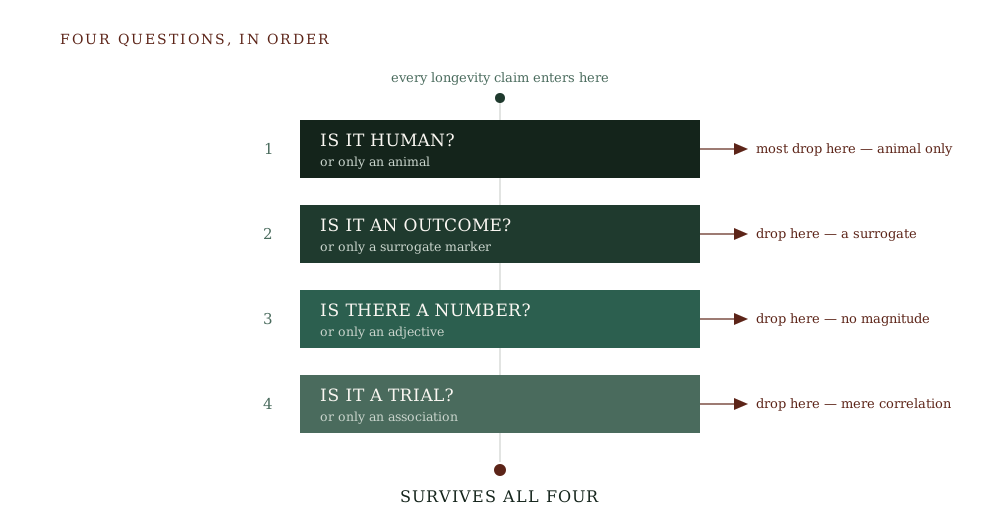
You will be handed confident longevity claims for the rest of your life, so take the tool rather than my conclusions. Four questions do most of the work. Is the evidence from an animal or a human? Is the thing being measured a hard outcome — you lived longer, you got a disease or you did not — or a surrogate, a marker that is only supposed to predict those things? How large is the effect, stated as an actual number rather than an adjective? And is it a controlled experiment or merely an association between two things that happen to travel together? Almost every longevity claim that collapses does so on one of those four, and almost every longevity claim worth taking seriously survives all four. Hold onto them; I will use them on my own examples as I go.
The science is real
Start with what is genuinely established, because it is the part the marketplace is parasitic on and it deserves to be stated cleanly.
Aging is not a single thing that simply happens; it is a set of specific, describable biological processes — damage that accumulates, cells that stop dividing but refuse to die, metabolic signalling that drifts. These have been catalogued, most influentially as a list of the “hallmarks of aging,” and the important claim in that work is that these processes are modifiable: intervene on them and, in animals, you can slow — and in some cases partially reverse — specific features of aging. And because these same processes sit upstream of heart disease, diabetes, dementia and cancer, the geroscience wager is that acting on aging itself would do more for human health than treating each disease one at a time after it arrives. That is a serious idea, held by serious people, and it is the legitimate core the whole field grows from.
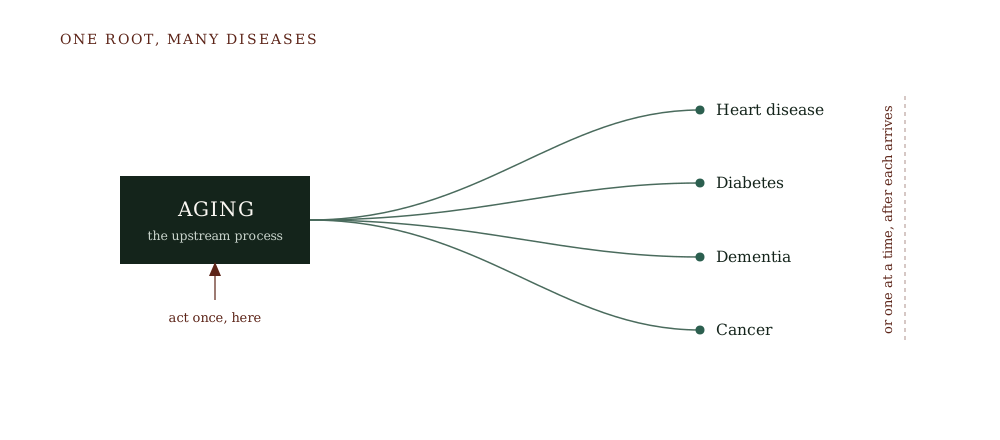
The trouble is that “modifiable in principle, upstream of disease” is a statement about biology, not yet a bottle you can buy — and the distance between those two is where almost all the damage is done.
The human evidence, stated honestly
So what actually has evidence in people? Less than the marketplace implies, and it is worth walking through precisely, magnitudes and all.
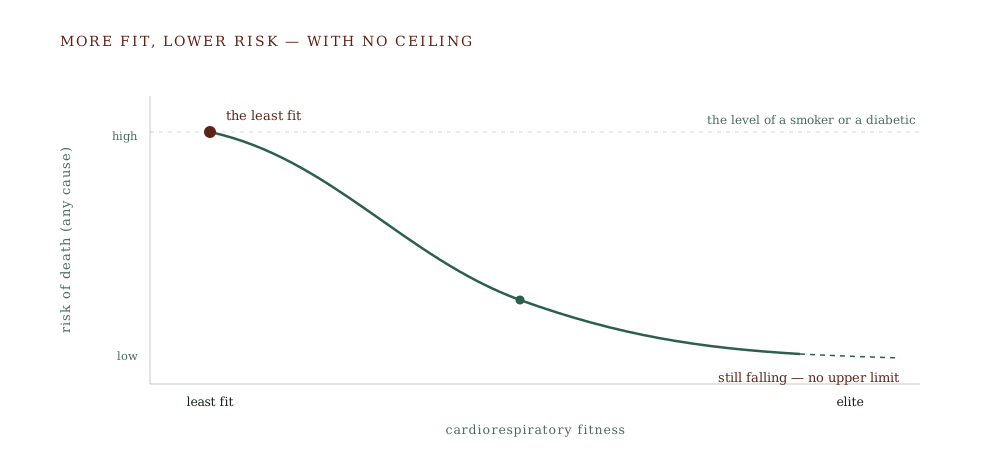
The strongest human signal is also the least commercial: cardiorespiratory fitness. In a study of well over a hundred thousand people, higher fitness tracked lower death from any cause in a graded, dose-dependent way, with — strikingly — no upper limit at which more fitness stopped helping, and being in the lowest fitness group carried a risk comparable to or greater than smoking or diabetes. That is about as strong as this kind of evidence gets. But apply the tool: it is an association, not a trial. It cannot fully separate “fitness makes you live longer” from “the kind of person who is fit is different in other ways too.” The signal is powerful and biologically sensible and I act on it — but it is observational, and I have to say so.
On the interventional side, a randomised trial of roughly two years of caloric restriction in healthy adults slowed one measure of biological aging — a so-called pace-of-aging clock — by around two to three per cent, while showing no effect on two other such clocks. Read that carefully, because it is a good example of an honest result being more useful than a hyped one. It was a real, randomised effect. It was also small, it was on a surrogate marker rather than a hard outcome, and it disagreed with the other markers in the same study. “Caloric restriction slowed aging” is technically supportable and wildly misleading if you drop the magnitude and the surrogate. And in the newer, more targeted work — drugs that clear worn-out “senescent” cells, for instance — the first human trials are genuine proof-of-concept and almost nothing more: a dozen or so patients, no control group, an improvement in a physical measure. That is exactly where the science honestly is: an early, promising human signal, not a therapy you should be buying.
The marketplace, graded on the same scale
Now turn the same four questions on the products, and watch most of them fail the first one.
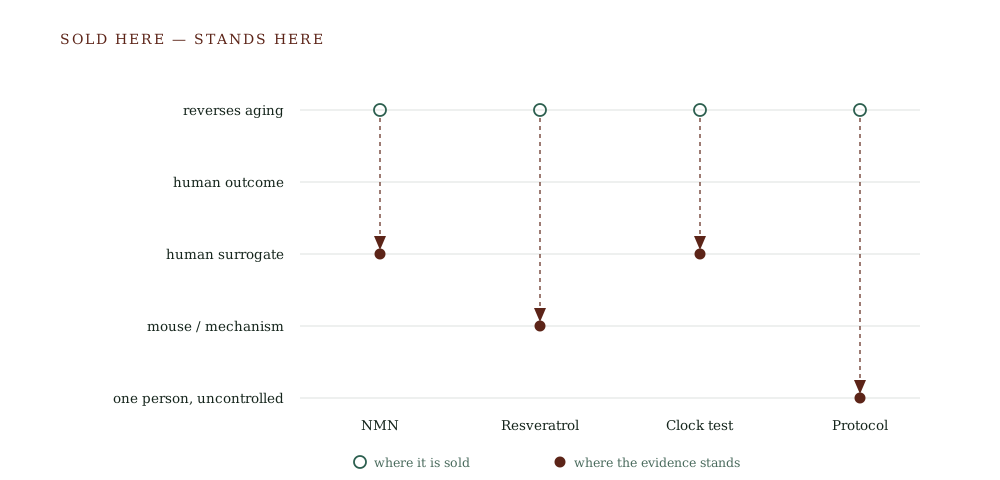
NMN and other NAD boosters are the flagship of the longevity supplement industry, sold on the promise of restoring youthful cellular energy. The mechanism is real and there is mouse data — but that is a statement about mice, and it predicts nothing about people until it is tested in people, which for lifespan or aging it has not been. In humans, the best you can honestly say is that a small trial found NMN improved one narrow thing — muscle insulin sensitivity in a specific group — while changing nothing else it measured, and no human study has shown that it extends life or reverses aging, because none has been done. Resveratrol, the red-wine molecule that launched a thousand headlines, has largely failed to reproduce in humans the effects that made it famous in yeast and mice. The epigenetic-clock test sold direct to consumers reports a “biological age” from a surrogate marker — and whether moving that number with any intervention actually changes your health has never been established, so you are paying to move a number whose meaning for you is unproven. And the elaborate personal “protocols” of the celebrity biohackers are, evidentially, a single person doing many things at once and measuring surrogates, which is a design that cannot tell you which if any of the interventions did anything, and cannot be generalised to you at all.
None of this means these compounds are worthless or that the research is fake; some of it may pan out. It means that, judged on species, endpoint, effect size and design, they are almost all sitting one to three rungs below where they are being sold, and the confident “reverse your age” claim printed on them is a claim no human trial currently supports.
What actually earns a recommendation
If I will not point you at a supplement, what will I point you at? The unglamorous things, which is once again how you can tell it is not a sales pitch.
The levers with the best human evidence for a longer, healthier life are cardiorespiratory fitness, preserved muscle mass and strength, control of blood glucose and metabolic health, and sleep. Every one of them is free or nearly so, none of them can be bottled and sold at a margin, and each has more behind it than any longevity supplement on the market. This is not a coincidence and it is not an accident of what has been studied; it is what the evidence, read honestly, keeps returning. The intervention with the best human evidence for slowing aging today is almost certainly the capacity of your own heart and lungs, and the second is the muscle on your frame. Neither has a brand.
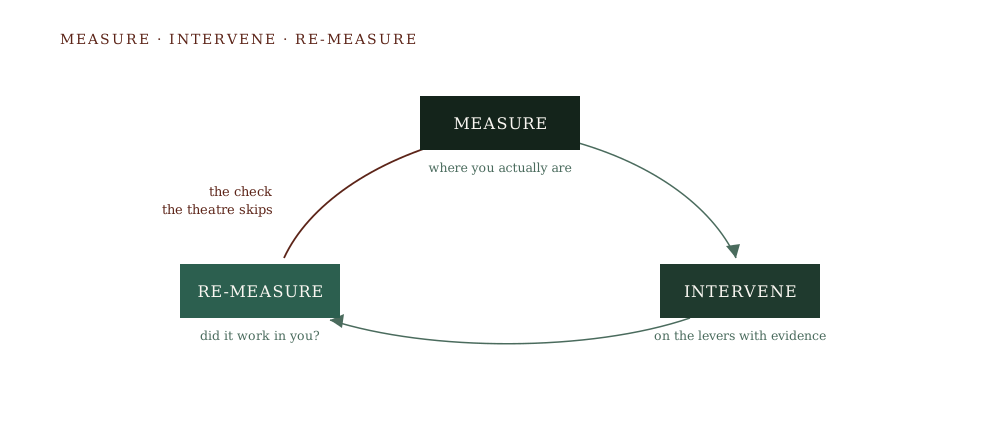
Where the precision comes in — the part that is genuinely clinical rather than generic advice — is not in adding exotic compounds but in measuring the individual and adjusting: establishing where your metabolic health, your fitness, your body composition actually are, intervening on the levers that have evidence, and re-measuring to see whether it worked in you. Measure, intervene, re-measure. That loop is the entire difference between geroscience and biohacking theatre. The theatre measures surrogates and sells certainty. The discipline measures outcomes it can actually check and stays honest about what it does not yet know.
What would change my mind
The claim I am defending is that, as of now, no supplement or “protocol” has human evidence that it extends healthy life, and that the real levers are the boring physiological ones. That is a statement about the current evidence, and it is built to move.
If a geroprotective drug — rapamycin and metformin are the leading candidates, both still in or awaiting the trials that would settle it — were shown in a well-designed human trial to extend healthspan or reduce age-related disease across the board, I would add it to the short list of things with real evidence, gladly. That is not a hypothetical hope; those trials are the field’s central project, and one of them, a large trial of metformin for aging, has struggled for years mostly to get funded. If it runs and it works, I will say so. Equally, if the fitness-and-muscle signal turned out under harder testing to be mostly confounding — the fit person living longer for reasons other than the fitness — I would have to weaken even the advice I am most confident in. Both are testable. Neither has resolved against my position yet. The moment either does, this essay updates.
A closing argument
The honest position on longevity is not the cynic’s — that it is all a scam — any more than it is the enthusiast’s, that we are on the verge of curing aging with a capsule. Aging is genuinely modifiable, the science is genuinely exciting, and the human evidence is genuinely thin in exactly the places the marketplace is loudest. Those three facts do not contradict each other; living with all of them at once is what taking the subject seriously requires.
So here is the whole of it, without a product attached. Aging is a real, upstream, modifiable process. The interventions that have earned human evidence are fitness, muscle, metabolic health and sleep — none of which is for sale. The supplements and protocols being marketed as anti-aging are, with few exceptions, sitting below the evidence they claim, and the honest ones among their makers will tell you the trials have not been done. And the way a clinician adds value is not by handing you a longevity stack but by measuring you, acting on what has evidence, and checking whether it worked. The people promising to reverse your age from a bottle are selling the one thing the science cannot yet honestly give. What it can give — a longer healthspan built from unglamorous, well-evidenced levers — is better, and it is real, and nobody can put it in a subscription.