There is a good chance this is on one of your medical reports and no one made much of it. A fatty liver is usually found by accident — a shadow on an ultrasound ordered for something else, a mildly raised liver enzyme on a routine blood panel — and it is usually dismissed with a single sentence: a bit of fat on the liver, lose some weight, come back in a year. What that sentence leaves out is nearly everything that matters. It does not say that this is now the most common liver disease in the world, that it is a visible sign of the same metabolic process that drives diabetes and heart disease, that in its early stages it is largely reversible, or — the part that matters most once the detox industry gets hold of you — that it cannot be reversed by cleansing the organ, because the organ in question is the one that does the cleansing.
I want to make two promises about how I will handle this, because fatty liver is a topic where both scaremongering and false reassurance are easy and profitable. I will not inflate the danger: most people who have fat in the liver and nothing else will never develop serious liver disease from it, and I will say so plainly. And I will not inflate the cure: the reversibility is real but it has a hard ceiling, and I will mark exactly where that ceiling is, so that “reversible” cannot be stretched over the whole disease when it only applies to part of it. The honest version of this subject lives between those two limits.
The disease named by what it is not
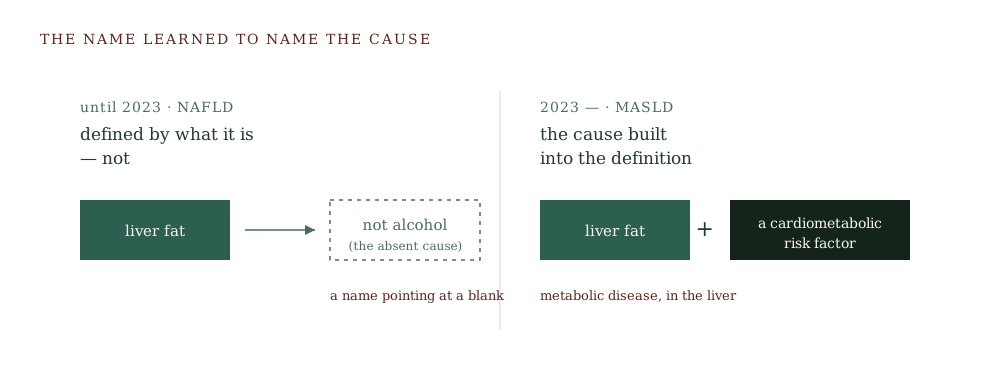
For decades this condition had a strange name: non-alcoholic fatty liver disease. Read it again — the disease was defined by what it was not. It was fat in the liver in a person who did not drink enough to explain it, and the name pointed at the absent cause rather than the present one. That was not an accident of language. It reflected a genuine gap in understanding: the field could see the fat and could rule out alcohol, but the actual driver was treated as a mystery to be worked out later.
In 2023 that changed. A consensus of the major international liver associations renamed the condition metabolic-dysfunction-associated steatotic liver disease — MASLD — and, more importantly than the mouthful, built the cause into the definition. Under the new criteria you cannot be diagnosed with it on the fat alone; you need the fat plus at least one cardiometabolic risk factor — raised glucose, raised blood pressure, the insulin-resistant pattern of blood fats, excess weight around the middle. The rename is the field saying out loud what it had learned: this is not a mysterious accumulation of fat that happens to sit near metabolic disease. It is metabolic disease, expressing itself in the liver. It is, in the language of the companion essay to this one, the liver’s face of the shared upstream root — the same insulin resistance that shows up as diabetes in the pancreas and as high blood pressure in the vessels, showing up here as fat in the liver.
How common, honestly
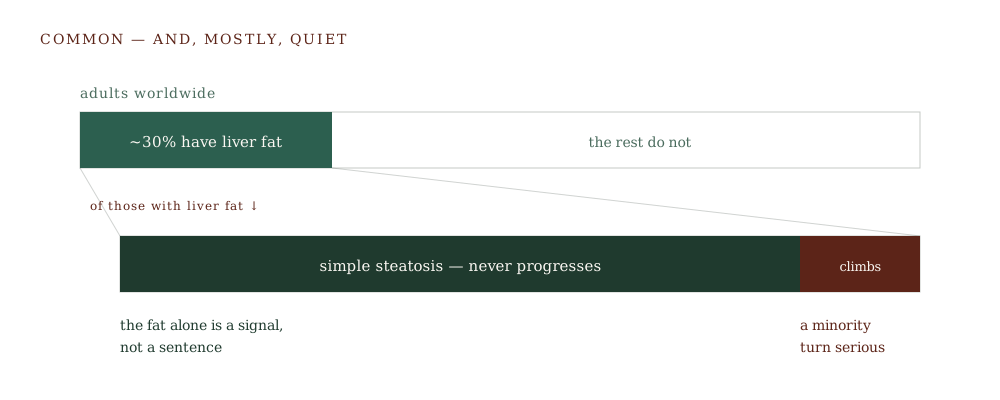
The scale is genuinely large, and it is worth stating with a real number rather than an adjective. The most-cited global estimate, a meta-analysis published in 2016, put the prevalence at around a quarter of the world’s adults; more recent pooled figures push toward thirty per cent. That makes it the most common chronic liver disease on earth, and it tracks the rise of obesity and type 2 diabetes almost exactly, which is what you would expect of a metabolic condition.
Now the counterweight, because it is the part the alarming version omits. Having fat in the liver, on its own, is common and usually not a catastrophe. The majority of people with simple steatosis — fat without significant inflammation or scarring — will live their whole lives without it progressing to serious liver disease. The fat alone is a signal, not a sentence. What separates the people who need to act urgently from the people who mainly need to correct their metabolism at a sensible pace is not whether there is fat, but what the fat has started to do to the tissue around it. Which is the next question, and the one the single-sentence dismissal never asks.
The ladder, and where reversibility ends
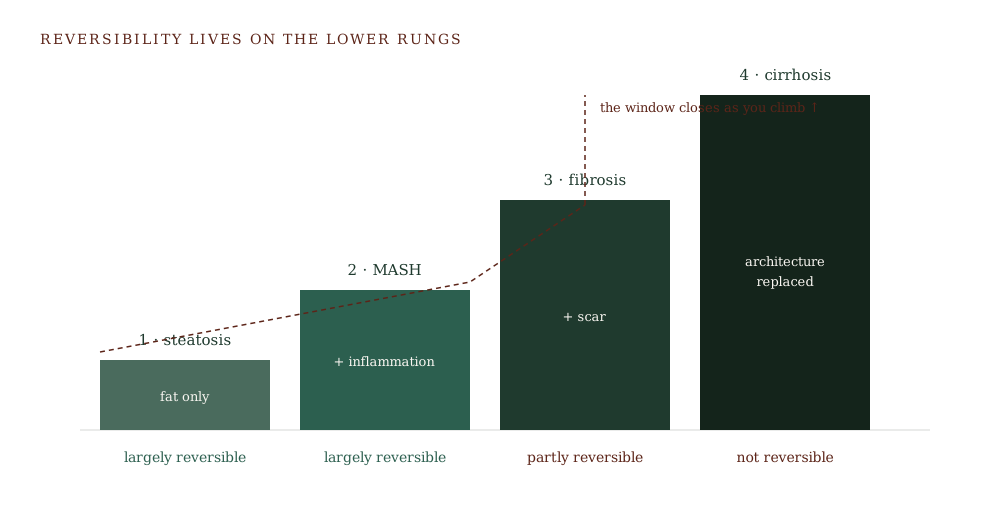
Fatty liver is not one state but a ladder, and knowing which rung you are on is the whole of the prognosis.
The first rung is simple steatosis: fat stored in the liver cells, without much else going on. The second is steatohepatitis — MASH, in the new naming — where the fat is now accompanied by inflammation and the liver cells are being injured. The third is fibrosis: the liver laying down scar tissue in response to that ongoing injury, a repair process that becomes a problem when it does not stop. The fourth is cirrhosis, where the scarring is so extensive that the architecture of the organ is replaced and its function fails. Liver cancer and liver failure live at the top of this ladder, not the bottom.
Here is where the discipline matters, because “fatty liver is reversible” is true on the lower rungs and false on the upper ones, and the difference is not a technicality — it is the difference between honest hope and a lie told to a dying organ. Simple steatosis is largely reversible. Early steatohepatitis is largely reversible. Fibrosis is partially reversible — the earlier stages can regress, but the more scar has been laid down, the less of it comes back. Cirrhosis is, for practical purposes, not reversible; at that point the goal changes from reversal to preventing decompensation and screening for cancer. Anyone who promises to reverse a cirrhotic liver with a protocol is not describing medicine. The reason to catch this early is precisely that early is where reversibility lives, and the window closes as you climb.
Why you cannot detox the organ that detoxifies you
Into the gap left by “lose some weight, come back in a year” steps an entire industry, and it sells the same idea in a hundred packages: the liver cleanse, the liver detox, the milk-thistle course, the juice regimen that will “flush” the fat away. I want to be precise about why this is not a matter of taste or emphasis but a category error.
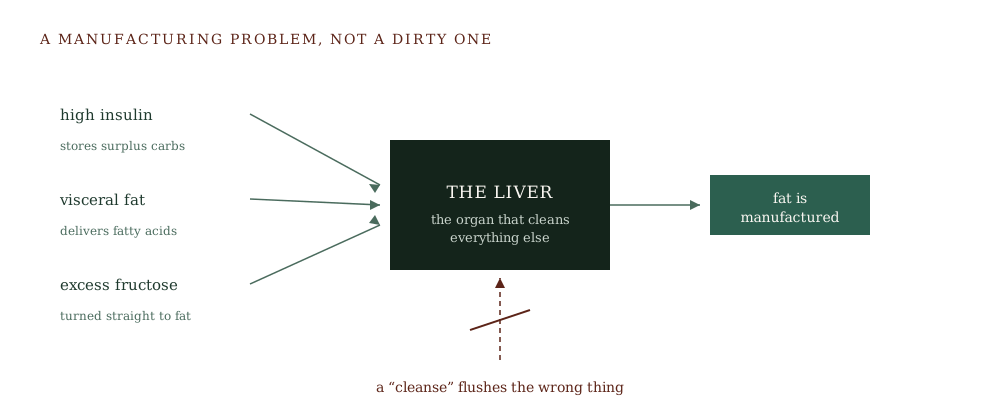
The liver is the organ that detoxifies you. It is the body’s central chemical processing plant — it metabolises drugs, breaks down the byproducts of your own metabolism, clears what needs clearing. You cannot “detox” it, because detoxification is the thing it does to everything else. Asking a supplement to cleanse your liver mistakes the cleaner for the thing that needs cleaning. And the empirical record matches the logic: no cleanse, no juice protocol, and no dose of milk thistle has ever been shown in a serious trial to reverse liver fibrosis. The fat did not arrive because the liver was dirty. It arrived because of a specific metabolic process — chronically high insulin instructing the liver to convert surplus carbohydrate into fat, a load of visceral fat delivering fatty acids to it, an excess of fructose that the liver preferentially turns into fat. The fat is a manufacturing problem, not a contamination problem. It leaves the way it came: by changing the manufacturing conditions, not by flushing the factory.
One distinction has to be held here, because it is where the argument can tip into a slogan. Saying that excess fructose drives liver fat is not the same as saying sugar is a toxin. It is not. It is a statement about dose and pathway: large amounts of added sugar, and fructose in particular, feed the specific process by which the liver manufactures fat, which is why cutting them is one of the levers that works. The fruit on your table is not the problem. The quantity of added sugar in a metabolically overloaded diet is part of it. Precision here is what separates a clinical statement from a diet-book slogan.
The lever that actually works
If the fat is a manufacturing problem, the fix is to change what the liver is being told to make — and the best-evidenced way to do that is unglamorous and specific. The reference point is a 2015 study that put people with steatohepatitis through a year of structured lifestyle change and then measured their livers by biopsy, so the result is tissue, not a blood marker. What it found was a dose-response, the same shape we saw with diabetes remission. Losing around seven to ten per cent of body weight resolved the steatohepatitis — the inflammation, the active injury — in the majority of people who achieved it. Losing ten per cent or more produced actual regression of fibrosis, of established scar, in roughly forty-five per cent. More weight cleared, more disease reversed, measured in the tissue itself.
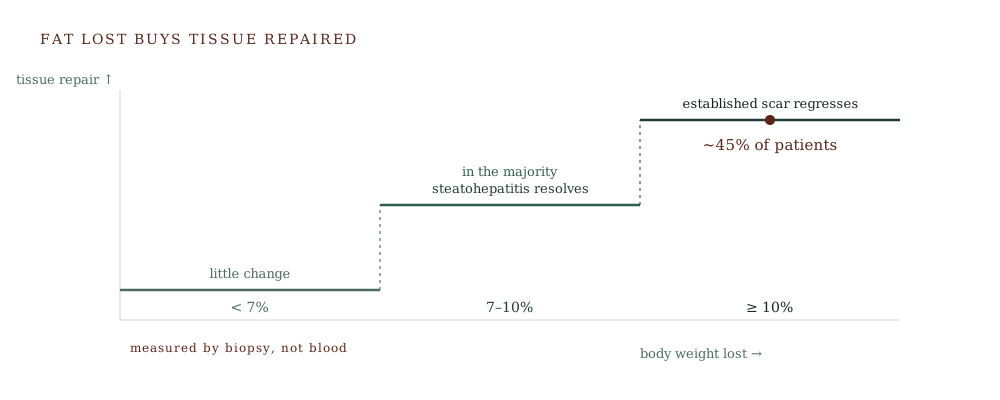
This is what a real lever looks like, and it is worth noticing how different it is in kind from a cleanse. It is graded rather than magical — a specific amount of fat loss buys a specific amount of tissue repair. It is mechanistic — you are removing the fatty acids and lowering the insulin that were driving the manufacturing. And it is bounded — it works best on the lower rungs of the ladder, which is the same discipline again. The instruction “lose some weight” was not wrong. It was just delivered without the number, without the mechanism, and without the plan, which is the difference between advice and care.
The ceiling on the cure
To keep myself honest about how hard this is, it is worth looking at the best that pharmaceutical medicine can currently do, because even that is partial — and if the licensed drug is partial, the cleanse is fantasy.
For most of this disease’s history there was no approved drug for it at all. In 2024 the first one arrived: a thyroid-hormone-receptor agonist that, in its pivotal trial, resolved steatohepatitis in roughly a quarter to a third of patients against about one in ten on placebo, and improved fibrosis in around a quarter against roughly one in seven. Those are real, meaningful numbers, and they represent a genuine advance. They are also the numbers of a drug that helps a minority, and it is licensed specifically for people with moderate-to-advanced fibrosis, not for the early fatty liver most people are told to ignore. The most-studied supplement, high-dose vitamin E, tells a similar story with a sharper edge: in the best trial it improved the inflammatory picture in non-diabetic patients but did not improve fibrosis, and high doses carry their own safety concerns. The lesson across all of it is consistent. Even the interventions that genuinely work, work partially, and none of them works by cleansing anything. The organ is corrected upstream or it is not corrected at all.
What would change my mind
Two findings would move the argument I have made here.
The first: if a properly designed trial showed that a specific supplement or “cleanse” regimen produced regression of liver fibrosis — actual reduction of scar on biopsy — independent of weight loss, then my claim that these products do nothing for the disease would be falsified, and I would have to revise it for that product. To be clear about the standard, this means tissue evidence against a real control, not testimonials and not improved blood enzymes, which can move for many reasons. To my knowledge no such trial exists. The absence is not for want of products to test.
The second: if longer and larger studies found that the weight-loss reversibility did not hold — that the histological improvement seen at one year faded, or failed to replicate, or did not translate into fewer people progressing to cirrhosis and cancer over time — then the central promise of early reversibility would need to shrink to a shorter-term cosmetic effect. So far the evidence runs the other way, and the staging logic is well supported. But the long-horizon outcome data is still maturing, and honesty requires holding the claim to the strength of the evidence actually in hand.
A closing argument
The single sentence most people get — a bit of fat on your liver, lose some weight, come back in a year — is not wrong, exactly. It is a diagnosis without a plan. And a diagnosis without a plan is an invitation, because the vacuum where the plan should be is precisely where the cleanse industry sets up its stall. The person who is told they have a fatty liver and given nothing to do about it is the ideal customer for someone selling a detox, and the tragedy is that the detox is not merely useless but conceptually confused, aimed at cleansing the very organ whose job is to cleanse.
The honest account is more useful and less dramatic. You very likely have the early, reversible form, which most people never progress beyond. The fat is there because of a metabolic process you can change, and the change has a known dose-response written in liver tissue, not in marketing copy. What it asks of you is not a cleanse but a correction — of the insulin, the visceral fat, the excess sugar that were instructing the organ to store fat in the first place. And it asks it with a real window, because the reversibility is a property of the lower rungs of the ladder and it narrows as the disease climbs. Your liver is not dirty. It does not need flushing, and it cannot be flushed. It is overloaded, by something specific, that can in most people still be unloaded — if someone tells you the truth about it in time.