In 2015 the Nobel Prize in Medicine went, in part, to a Chinese scientist named Tu Youyou, for artemisinin — a malaria drug that has saved millions of lives and that came, originally, from a herb used in Chinese medicine for more than a thousand years. It is the story most often told to prove that traditional wisdom was right all along. But the part usually left out is the part that matters, because it says the opposite. The tradition pointed to the right plant and got the preparation wrong; the drug only emerged when modern chemistry corrected it. That is not a footnote. It is the whole lesson of this essay.
I write this as someone whose practice is built, in part, on the Asian medical inheritance, and precisely because I value that inheritance I want to defend it in the only way that survives scrutiny — not as ancient wisdom, but as an enormous, unindexed library of bioactive molecules, assembled over centuries by trial and error, most of its entries useless or harmful, a few of them extraordinary. The library is real and valuable. But a library is not knowledge until someone reads it critically, and the reading — the isolation, the dosing, the controlled trial — is what turned a handful of its entries into medicine. Revere the reading, not the shelf.
The artemisinin story, told properly
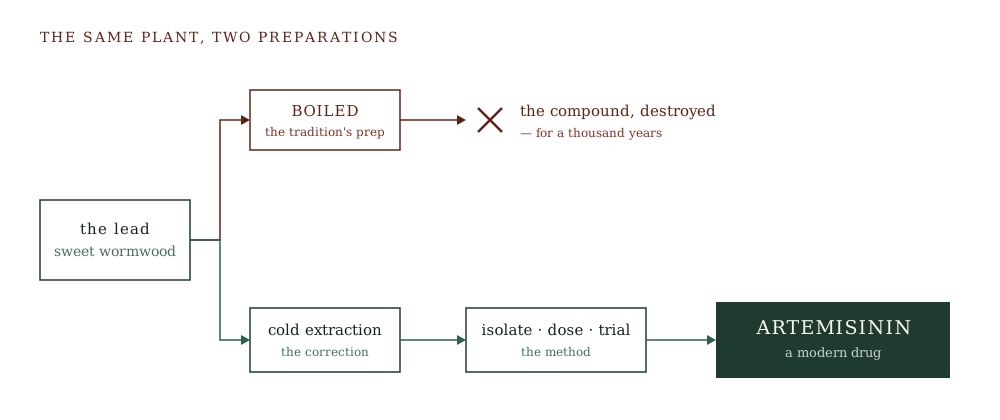
Tu Youyou’s team, working through a secret Chinese military program in the early 1970s, screened thousands of traditional recipes for something that would kill the malaria parasite. The herb qinghao, sweet wormwood, kept appearing in the old texts. But when they prepared it the traditional way — boiling it — it did not reliably work. The breakthrough came from reading an old text more carefully than the tradition itself had: a fourth-century manual by Ge Hong instructed the reader to soak the herb in cold water and wring out the juice, not to boil it. That single detail told Tu something a chemist would recognise: heat was destroying the active compound. She switched to a low-temperature ether extraction, and the antimalarial activity appeared, clean and reproducible. From there it was chemistry all the way — isolating the molecule, characterising its structure, establishing the dose, running the trials.
Read that sequence and notice what did the work. The tradition supplied the lead: this plant, for these fevers. But the tradition’s own standard preparation destroyed the very thing that made the plant work, and had done so for centuries. What rescued it was not deeper reverence for the old ways; it was a chemist treating the text as a source of hypotheses and the laboratory as the judge. The plant was traditional. The medicine was modern. Both statements are true, and only holding both keeps you honest.
The ones that survived the test
Artemisinin is not alone, and the honest way to make the case for the pharmacopoeia is to name the winners precisely — with the trial, not the tradition, doing the certifying.
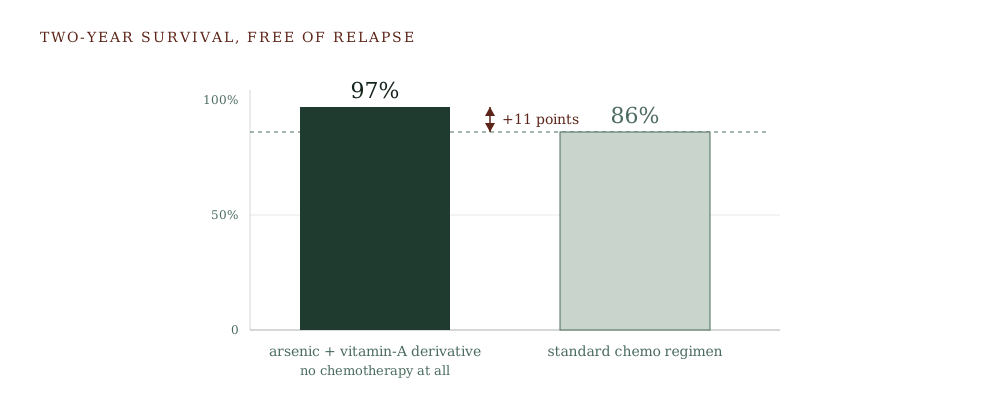
The most striking is arsenic. Arsenic compounds appear in traditional Chinese materia medica as poisons pressed into medical use, which sounds like exactly the kind of thing modern medicine should reject — and for most of its uses it should. But arsenic trioxide, isolated and dosed and tested, combined with a derivative of vitamin A, turned out to produce something close to a cure for a specific and once-lethal blood cancer, acute promyelocytic leukaemia. In a randomised trial, that combination — with no conventional chemotherapy at all — produced, in the standard-risk form of the disease, a two-year survival free of events of around ninety-seven per cent, against about eighty-six per cent for the standard chemotherapy-based regimen. A traditional poison became a targeted, life-saving drug. But notice, again, what certified it: not its long use, which was as a poison, but its isolation, its dose, and a controlled trial.
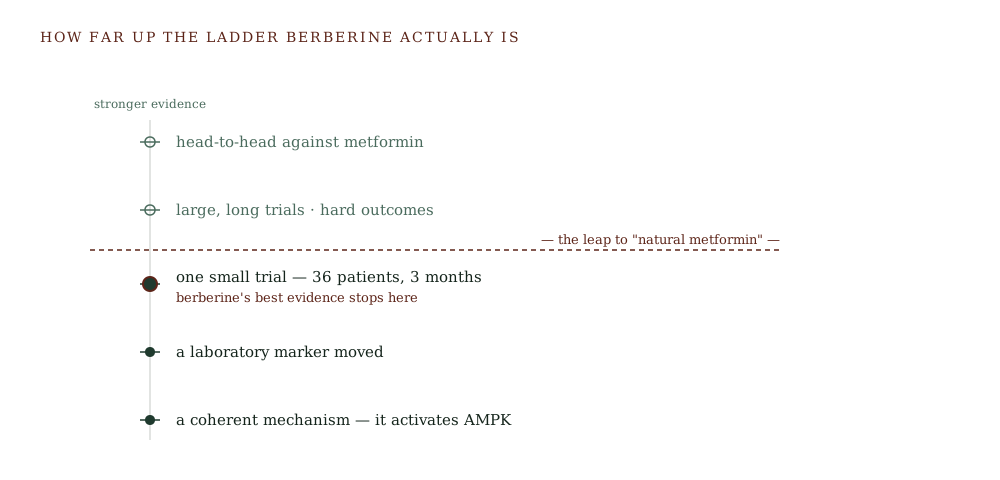
Then there is berberine — which belongs in this section only provisionally, and shows exactly why the line between a survivor and a hopeful matters. It is a compound from the huanglian root long used in the Asian pharmacopoeia, and the one I want to handle most carefully because it is being marketed the hardest. Berberine has a genuine, well-characterised mechanism — it activates an energy-sensing enzyme called AMPK, by a route that overlaps with how the diabetes drug metformin works — and in one small trial it lowered a blood-sugar marker over three months to a degree comparable with metformin: a laboratory number moved, not a hard outcome like a heart attack or a death prevented, and no head-to-head trial has ever pitted berberine against metformin on the outcomes that matter. That is a real signal, and it is mechanistically coherent, which is exactly why it is being sold across the internet as “nature’s Ozempic” or “natural metformin.” So let me be precise in the way the marketing is not: the trial that everyone cites had thirty-six patients and ran for three months. That is a promising early result. It is not a licensing-grade body of evidence, it says nothing yet about long-term outcomes or safety, and the leap from it to “natural metformin” is exactly the leap this essay exists to refuse. The signal is real. The certainty being sold on top of it is not.
The ones that failed — and why naming them is the point
Here is where most tributes to traditional medicine go quiet, and where an honest one has to get loud, because the failures are not embarrassing exceptions to be hidden. They are the control group. Without them, the winners are just survivorship bias — the famous few remembered, the many forgotten.
Ginkgo biloba, one of the most widely sold traditional remedies on earth, was marketed for memory for decades. When it was finally put through a large, rigorous, randomised trial — several thousand older adults, followed for years — it did not reduce the incidence of dementia or Alzheimer’s disease at all. Curcumin, the compound in turmeric, generates dazzling results in the test tube and a mountain of hopeful headlines. But it is chemically the kind of molecule that lights up laboratory assays while being too poorly absorbed and too unstable to ever translate — and across a great many trials, it has not. And ephedra, ma huang, a traditional remedy for respiratory complaints, was sold as a stimulant and weight-loss aid until it was withdrawn in several countries because it was causing heart attacks and strokes. Traditional. Widely used. Harmful.
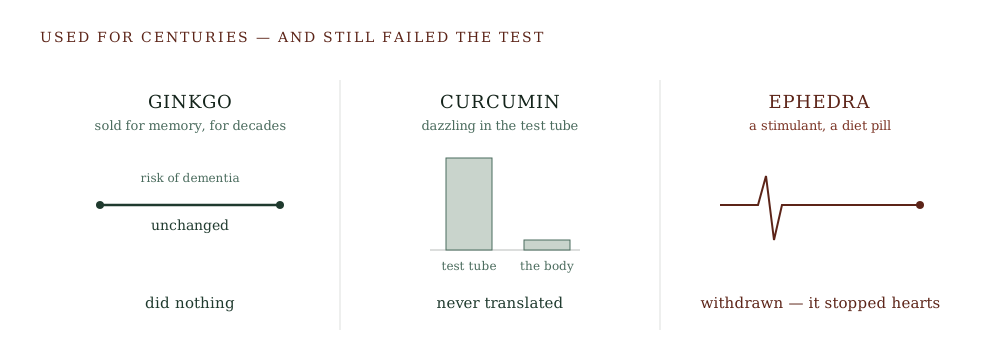
Put those three in the same frame as artemisinin and arsenic and berberine, and the real shape of the pharmacopoeia appears. It is not a body of validated wisdom. It is a vast set of hypotheses of wildly varying quality, and the only thing that sorts the artemisinin from the ephedra is the test. “It has been used for centuries” is true of every item on both lists. It is therefore not evidence of anything except that people tried it. Long use tells you a compound was available and tolerated often enough to persist; it does not tell you the compound works, and in the case of ephedra it did not even tell you it was safe.
The inversion the “West versus East” story gets wrong
There is a nationalist version of this subject that says Western medicine arrogantly dismisses Eastern remedies and steals the ones that work. It is worth addressing directly, because it is both emotionally satisfying and, on the evidence, backwards.
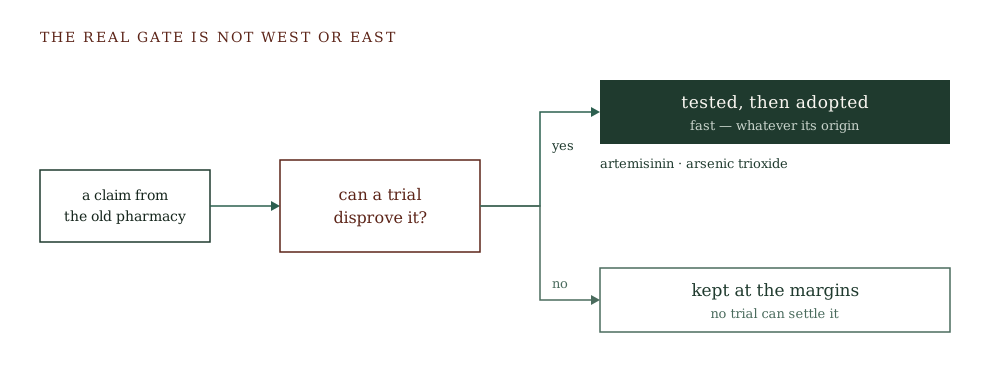
Look at what actually happened with the winners. Artemisinin’s global adoption did lag — roughly two decades passed between its first international publication and the World Health Organization’s front-line recommendation — but the obstacles were logistical and political: manufacturing scale, funding, patents, institutional caution. They were not a refusal of the compound’s Eastern origin. Once the falsifiable claim was settled, mainstream medicine had no ideological objection to it, and artemisinin is now the WHO’s front-line recommendation for malaria. Arsenic trioxide became standard of care for its leukaemia. The compounds that came from the Asian pharmacopoeia and passed rigorous testing were adopted, fast, and without much regard for their origin. What mainstream medicine resists is not plant compounds, and not Eastern origin. It is unfalsifiable claims — assertions built so that no trial could disprove them. Artemisinin was a falsifiable claim: give this compound, at this dose, and malaria parasites die, or they do not. It did, so it won. The parts of the traditional system that remain marginalised are, overwhelmingly, the parts that have not been rendered into that testable form. The gate is not Western or Eastern. It is falsifiable or not.
What would change my mind
The thesis here is that the credit for the pharmacopoeia’s genuine victories belongs to the method that tested its compounds, not to the tradition that stored them. Like any real position, it should say what would overturn it.
If a traditional remedy — used as the tradition actually uses it, as a whole preparation rather than an isolated and re-engineered compound — were put through a rigorous randomised trial and clearly improved a hard clinical outcome, then the claim that only isolation-plus-testing yields medicine would need softening; the whole preparation would have earned its place on the same terms I am demanding of everything else. This is not impossible, and there are a few traditional formulations in registered trials; to date none has cleared that bar, and until one does the concession stays hypothetical. If one passes, I will say so, and adjust. Equally, if the compounds I have called winners failed on longer or larger testing — if berberine’s signal evaporated in a proper trial, or artemisinin resistance made the win hollow — I would have to revise the roster. The point is not that the traditional list is worthless; parts of it are treasure. The point is that the test, not the tradition, is what tells treasure from poison, and I would abandon that position only if the test itself were shown to be the wrong judge.
A closing argument
The old pharmacy got a great deal right, in the specific and limited sense that matters: it pointed, again and again — amid far more misses than hits — at plants and minerals that turned out to contain something real. That is a genuine achievement and I have no wish to diminish it. But pointing is not knowing. The tradition pointed at sweet wormwood and boiled the medicine out of it for a thousand years; the tradition pointed at arsenic and mostly poisoned people with it; the tradition pointed at ginkgo, which does nothing for memory, and at ephedra, which stops hearts. It also pointed at artemisinin, and at the arsenic protocol that cures a leukaemia, and — if a proper trial ever confirms it — possibly at berberine, and we know which of those pointings were real only because someone isolated the compound, fixed the dose, and ran the trial.
So by all means honour the inheritance. I do. But honour it correctly — as a library of leads, most of them dead ends, a few of them extraordinary, none of them true until tested. The mysticism that surrounds it adds nothing and obscures much; the molecules and the method are where the medicine actually lives. The most respectful thing you can do with the old pharmacy is not to revere it. It is to read it the way Tu Youyou read Ge Hong: as a clever, fallible source of hypotheses, worth everything as a starting point and nothing as a final word.