Consider a common patient. She is in her forties. One specialist manages her type 2 diabetes, another is watching the fat accumulating in her liver, a third has her on one tablet for blood pressure and another for cholesterol, and years earlier a fourth gave her the diagnosis of polycystic ovary syndrome. Five conditions, four departments, a fistful of daily medications, and a calendar of appointments that never quite speak to one another. What she has almost certainly never been told is that these may not be five diseases at all. They may be one — a single upstream fault, expressing itself in five organs, wearing five names because our medicine is organised by organ rather than by cause.
I have to state a limit before I state the claim, because the claim is the kind that gets abused the moment it leaves the room. Insulin resistance is a major shared driver of this particular cluster of conditions. It is not a theory of everything. There are people whose fatty liver is largely genetic, whose diabetes is of a lean or atypical type, whose polycystic ovaries do not run mainly through insulin at all; there is high blood pressure and there is heart disease with little or nothing to do with it. Anyone who tells you insulin resistance is behind every chronic disease has stopped doing science and started selling a diet. The claim worth making is narrower and much sturdier: for a large fraction of the people carrying this specific constellation, one upstream fault is doing much of the work downstream — and unlike the five diagnoses it produces, the fault itself is treatable.
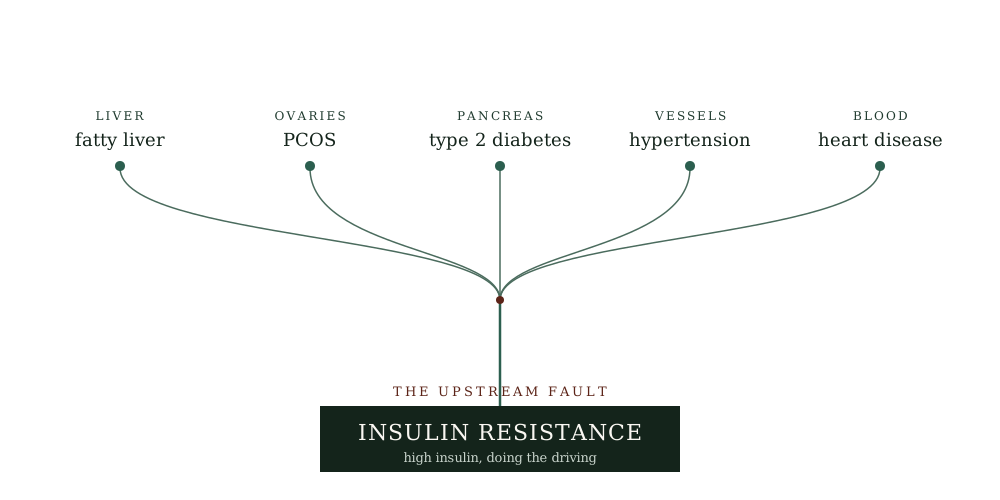
Five doors, one room
Modern medicine is organised by organ. The endocrinologist has the pancreas and its hormones, the hepatologist has the liver, the cardiologist has the heart and vessels, the gynaecologist has the reproductive system. This division has been extraordinarily productive; specialisation is much of why medicine can do what it does. But it has a structural blind spot, and the blind spot is precisely the kind of problem where one cause surfaces in several organs at once. A disease that lives in one organ is seen whole by the specialist who owns that organ. A disease that lives upstream of all of them is seen by each specialist only as the piece that has drifted into their territory — and by no one as the thing itself.
So the patient with the shared upstream fault does not get diagnosed with the fault. She gets diagnosed, separately and correctly, with each of its downstream expressions. The endocrinologist is right that she has diabetes. The hepatologist is right that she has a fatty liver. Each diagnosis is accurate. What is missing is not accuracy but altitude — the vantage point from which five accurate diagnoses resolve into one physiological process. There is usually no one in the building whose job is to occupy that vantage point. That is not a failure of any individual specialist. It is a property of how the building is laid out.
The upstream fault
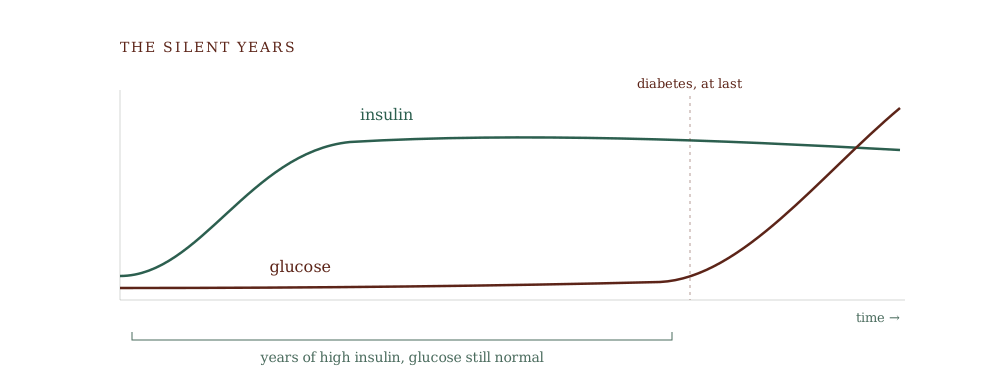
Here is the fault itself, in plain terms. Insulin is the hormone that tells cells to take glucose out of the blood. In insulin resistance, the cells stop listening well; they respond sluggishly to a given amount of insulin. The body’s response to being ignored is to shout louder — the pancreas secretes more insulin to force the same effect. For a long time this works. Blood glucose stays normal, and the only abnormality, if anyone measured it, would be the quietly elevated insulin doing the forcing. This is the crucial and under-appreciated part: for years, often, the problem is not high glucose but high insulin, and high insulin is not a passive marker. It is itself an active driver, and it does damage in different organs in different ways.
In the liver, insulin is a signal to store and to build fat. Chronically high insulin drives the liver to manufacture fat from carbohydrate — the process has the forbidding name of de novo lipogenesis — and that fat accumulates inside the liver. This is the same fatty liver a hepatologist diagnoses, and it is not a coincidence that the field renamed the condition in 2023 to metabolic-dysfunction-associated steatotic liver disease, building the metabolic cause into the name itself. In the ovaries, high insulin stimulates the production of androgens and lowers the protein that normally keeps those androgens bound and inactive, so more free androgen circulates — the hormonal signature of polycystic ovary syndrome, which is why so many women with PCOS are found to be insulin-resistant, including many who are not overweight. In the kidneys and blood vessels, insulin promotes the retention of sodium and raises the activity of the sympathetic nervous system, both of which can push blood pressure up — though of the five organ effects this is the least settled, and how much of any given person’s hypertension actually runs through insulin remains genuinely contested. In the bloodstream, the insulin-resistant state produces a characteristic pattern of blood fats — high triglycerides, low protective HDL, and a shift toward the small dense LDL particles most associated with arterial disease. And glucose itself only rises, into diabetes, at the end of this sequence, when the overworked pancreas can no longer shout loudly enough to keep it down.
One fault. Five organs. Five specialists. Five diagnoses. One driver underneath all of them.
The Syndrome X that named it
None of this is new, and none of it is fringe — a point worth making plainly, because the shape of this argument resembles the shape of a great deal of nonsense, and the resemblance is the grifter’s cover. The idea that these conditions share a single metabolic root has a precise and prestigious origin. In 1988 Gerald Reaven, an endocrinologist at Stanford, delivered the Banting Lecture — the most distinguished annual address in diabetes medicine — and used it to propose that insulin resistance and the high insulin it provokes were the common thread linking glucose intolerance, the characteristic disturbance of blood fats, high blood pressure, and coronary heart disease. He called the cluster Syndrome X. The name that stuck was metabolic syndrome, and it is now a standard clinical category with formal diagnostic criteria used around the world.

I raise this not to lean on authority but to locate the claim correctly. When I say these conditions share an upstream driver, I am not floating a wellness theory. I am describing a model that entered mainstream endocrinology through its most formal front door nearly four decades ago, has accumulated evidence since, and is taught in medical schools. What has not happened is the translation of that model into how the individual patient is actually managed. The category exists in the textbook. The care is still delivered one organ at a time.
The test of a real cause
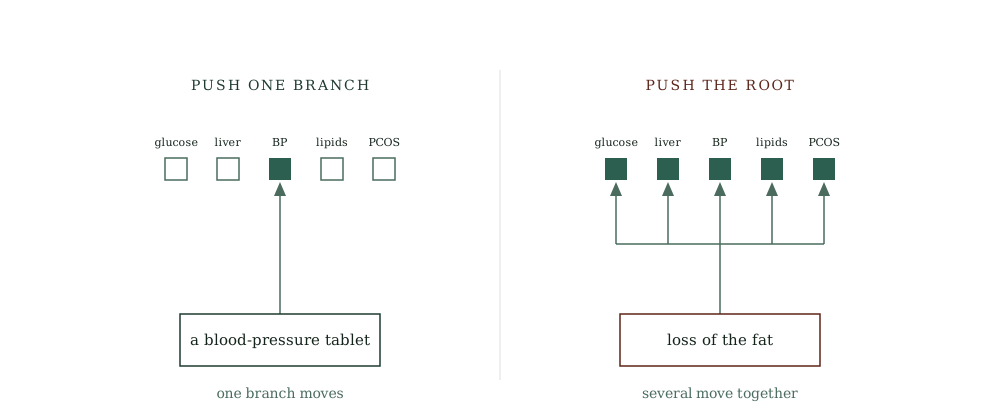
A shared correlation is not a shared cause. Five conditions that travel together might all be driven by one upstream fault, or they might merely share a common risk factor without any of them causing the others, or the arrows might point in directions I have not considered. The way to tell the difference is the test that separates a genuine cause from a story: if insulin resistance really is the upstream driver, then acting on it — reducing it — should move the downstream conditions. Not one of them. Several of them, together, from a single intervention. That is the fingerprint of a real root, and it is exactly what the evidence shows.
The Diabetes Prevention Program, published in 2002, took people on the road to type 2 diabetes and showed that an intensive lifestyle intervention aimed squarely at the insulin-resistant state cut the progression to diabetes by fifty-eight per cent — more than the drug arm achieved. Act on the driver, and the diagnosis downstream is prevented. The DiRECT trial, which I have written about separately, showed that substantial loss of the fat driving the fault can put established type 2 diabetes into remission, and that the remission tracks the fat almost linearly. In the people whose cluster actually runs through insulin resistance, the same fat loss that clears the liver and lifts diabetes also, in study after study, lowers blood pressure, improves the insulin-resistant lipid pattern, and eases the features of PCOS — and what does the work is the fat lost, not the brand of diet that removes it. This is the observation that matters: a single upstream intervention moves several downstream diagnoses at once — the fingerprint of a shared root, though not yet proof the root is insulin specifically, since losing fat changes more than insulin alone. I return to that caveat below. Drugs aimed at each organ separately do not do this — a blood-pressure tablet does not improve the liver, a statin does not restore ovulation. In the people for whom the root is doing the driving, an intervention aimed at it can move several branches at once. That is what a shared root looks like when you push on it.
Where the root is not the whole story
Now the concession, in full, because it is the difference between what I am saying and what the internet is saying with the same words.
Insulin resistance is a major driver of this cluster. It is not the only driver of any single condition in it, and it is not the driver at all in some people who nonetheless have the diagnosis. Fatty liver has a well-described genetic form, carried by variants such as PNPLA3, that produces liver fat with little or no metabolic syndrome behind it. There are lean phenotypes of both type 2 diabetes and polycystic ovary syndrome in which the insulin story is a smaller part of the picture. Plenty of high blood pressure is essential hypertension with no meaningful insulin component, and plenty of heart disease is driven by things — genetics, kidney disease, inflammation — that have nothing to do with any of this. A model that explains a lot is not a model that explains everything, and the moment you treat it as explaining everything you have left medicine for ideology.
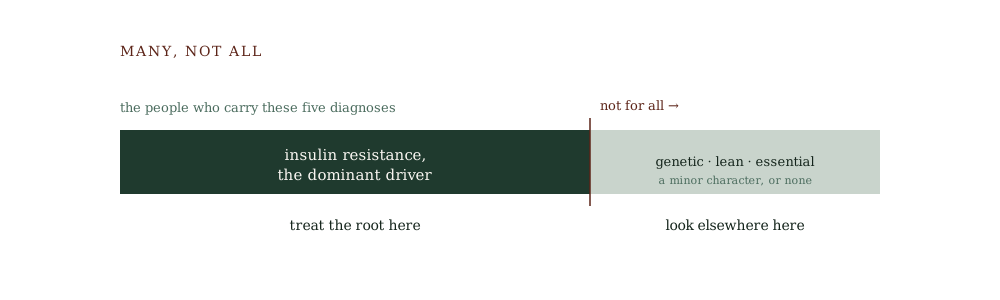
This is exactly where the popular version goes wrong, and it goes wrong in a specific and profitable direction. It takes a real and important shared driver and inflates it into a single cause of all human illness, and then — reliably — attaches a single branded solution to the single cause: one diet, one fast, one supplement, one protocol that reverses everything because everything was one thing all along. That is not this argument. This argument requires the opposite discipline. It requires working out, for a particular person, whether insulin resistance is actually their dominant driver or a minor character, how much of their specific cluster runs through it, and what the right-sized intervention is for them rather than for a slogan. The reason to identify the shared root is not to prescribe one thing to everyone. It is to stop prescribing five things to someone whose problem is upstream of all five.
What would change my mind
Two findings would substantially revise the argument above.
The first: if trials that reduce insulin resistance reliably improved one condition in the cluster but failed to move the others — if clearing liver fat, say, did nothing for glucose or blood pressure across enough studies — then insulin resistance would be a driver of some conditions but not the shared driver of the cluster, and I would have to shrink the claim to fit. So far the pattern runs the other way: interventions aimed at the root tend to move several branches together, which is the whole basis of the argument. But the claim is exactly the kind that this evidence could undercut, and it should be held open to it.
The second: if it turned out that the clustering of these conditions were better explained by a different shared factor — a common genetic architecture, say, or chronic inflammation as the true upstream event with insulin resistance merely one of its consequences — then insulin resistance would be a passenger dressed as a driver, a marker of the real cause rather than the cause itself. This is a live scientific question, not a settled one, and the honest position is that insulin resistance is the best-evidenced shared driver we currently have for this specific cluster, not that the case is closed.
Neither of these has happened. Until one does, the argument stands as stated: a major, treatable, shared root beneath a specific group of diagnoses — for many of the people who carry them, though not for all.
A closing argument
Nothing here says fire your specialists or stop your medications. The endocrinologist, the hepatologist, the cardiologist are each doing real and necessary work, and for many people the drugs aimed at each organ are exactly right and should continue. The problem is not that any of the five diagnoses is wrong. The problem is that five correct diagnoses, delivered by five people who never meet, can add up to a picture no one is actually looking at.
What I am arguing for is not another specialist to add to the list. It is the altitude the list is missing — someone whose job is to ask whether the five names describe five diseases or one physiology, to work out how much of a given person’s cluster runs through the shared root, and to aim an intervention at that root rather than adding a sixth prescription to the pile. Done honestly, this is unglamorous and highly individual work. It is the opposite of the one-diet-cures-all version that borrows its vocabulary. But for the patient in her forties with five diagnoses and four departments and no one asking the upstream question, it is very often the most useful question in the room — and the one her care was never structured to ask. She was handed five diagnoses. She may have been handed one physiology, five times, under five different names.