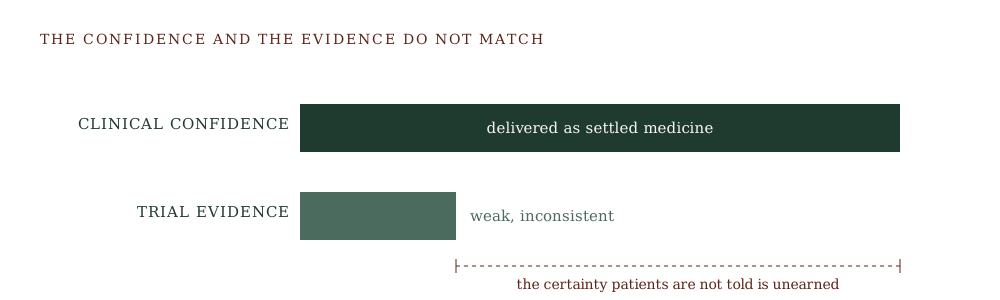
There is a recommendation that nephrologists give to almost every chronic kidney disease patient at some point in their care. It is delivered with the confidence of well-established medicine. The evidence supporting it is considerably weaker than that confidence suggests. And the harm it produces — slow, cumulative, rarely connected back to the recommendation that caused it — is a genuine clinical problem that conventional management is only beginning to acknowledge.
The recommendation is to eat less protein.
It is given to patients across the CKD spectrum, from early-stage to dialysis-dependent. It is delivered alongside other dietary cautions — less salt, less phosphorus, less potassium depending on stage — and is treated as part of the standard package of kidney care. Most patients accept it without question. Most clinicians deliver it without question. And the result, across millions of patients globally, is a population of people who have been told that protein is something their kidneys cannot handle, and who have spent years quietly under-eating one of the macronutrients most critical to their physical recovery.
This article argues that the standard protein restriction recommendation in chronic kidney disease is — for most patients in early-to-mid stages — wrong, harmful, and based on weaker evidence than the medical system acknowledges. It also argues for what serious functional medicine actually does instead: adequate protein, calibrated to the patient and their clinical picture, paired with a renal-supportive protocol that addresses the underlying drivers of disease. That approach, in clinical practice, produces outcomes the conventional model does not.
This is not a critique of nephrologists. They are following the guidelines they were trained to follow. It is a critique of the guidelines themselves, and of how they have persisted on theoretical grounds long after their evidentiary basis began to look shaky.
Where the recommendation came from
The theoretical case for protein restriction in CKD is straightforward and not unreasonable on its face. Protein metabolism produces nitrogenous waste — urea, creatinine, and several smaller compounds — that the kidneys must filter and excrete. Reduce the protein intake, the reasoning goes, and you reduce the metabolic load on already-impaired kidneys, theoretically slowing further damage. Combined with the observation that severely malnourished patients often have lower urea levels than well-nourished ones, the recommendation took shape across the 1970s and 1980s and entered mainstream nephrology guidelines.
The largest formal test of this hypothesis was the Modification of Diet in Renal Disease trial — the MDRD study — funded by the United States National Institutes of Health and conducted from 1989 to 1993. It enrolled hundreds of patients across multiple centres, randomised them to different levels of protein intake, and followed them for an average of two to three years. The primary results were published in the New England Journal of Medicine in 1994.
The findings were not what nephrology had expected.
The MDRD trial failed to demonstrate a clear benefit of protein restriction on the rate of CKD progression over the two-to-three-year follow-up period. The signal was weak, inconsistent across subgroups, and did not support the confident clinical recommendation that had already been built around the theoretical argument. Subsequent secondary analyses by the original investigators worked hard to rescue the recommendation through reinterpretation, but the primary finding remained: protein restriction had not done what it was supposed to do.
What happened next is more interesting. Long-term follow-up of the MDRD participants was published in the American Journal of Kidney Diseases in 2009, looking at outcomes over a decade after the trial ended. The results were striking. The very-low-protein arm — patients who had been assigned to 0.28 grams of protein per kilogram of body weight per day, supplemented with keto-acid analogs — did not show delayed progression to kidney failure compared with the low-protein arm. They did, however, show a higher risk of all-cause mortality.
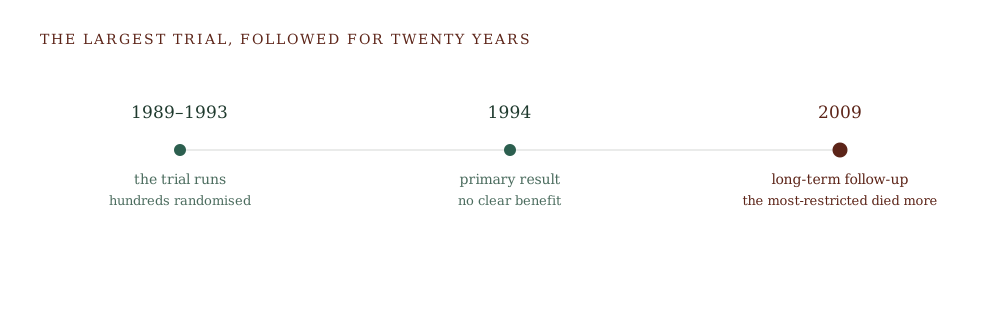
The patients who had been most aggressively restricted, in other words, did not protect their kidneys better. They died at higher rates.
This is not an obscure finding buried in the orthomolecular literature. It is a long-term follow-up analysis of the largest formal trial of protein restriction in CKD, published in the leading mainstream nephrology journal, by the same investigators who designed the original trial. And it is not what most patients on protein-restricted diets have been told.
The harm side that does not get discussed
The MDRD long-term mortality finding is not isolated. It sits within a substantial body of evidence on what happens to CKD patients when their protein intake is inadequate.
In 2008, the International Society of Renal Nutrition and Metabolism — ISRNM, the major professional body for renal nutrition science — formally defined and named a clinical syndrome that has since become one of the most studied complications of chronic kidney disease. They called it protein-energy wasting, abbreviated PEW. It refers to the loss of muscle mass, reduction in body protein stores, and metabolic dysfunction that develops in CKD patients across the disease spectrum, particularly as kidney function declines and dietary restrictions accumulate.
The clinical implications of PEW are not subtle. It is now recognised as one of the strongest single predictors of mortality in CKD patients. A 2019 review in the Journal of Cachexia, Sarcopenia and Muscle documented hazard ratios for mortality of approximately 3.0 in haemodialysis patients with PEW compared with those without — meaning the patients who develop this syndrome die at roughly three times the rate of those who do not. The prevalence estimates are sobering: 28 to 54 percent of patients on maintenance dialysis meet criteria for protein-energy wasting. The condition is not rare. It is the rule among advanced CKD patients, and it is increasingly recognised in earlier stages too.
The causes of PEW are multifactorial — chronic inflammation, metabolic acidosis, hormonal dysregulation, anorexia related to uremia — but inadequate protein and energy intake is one of the major contributors, and one of the few that is directly modifiable. Patients who are aggressively counselled to restrict protein, who develop the appetite suppression that often accompanies CKD, who are told that their dietary caution is part of their kidney protection, drift over time into a state in which their muscle mass declines, their physiological resilience erodes, their immune function weakens, and their mortality risk climbs.
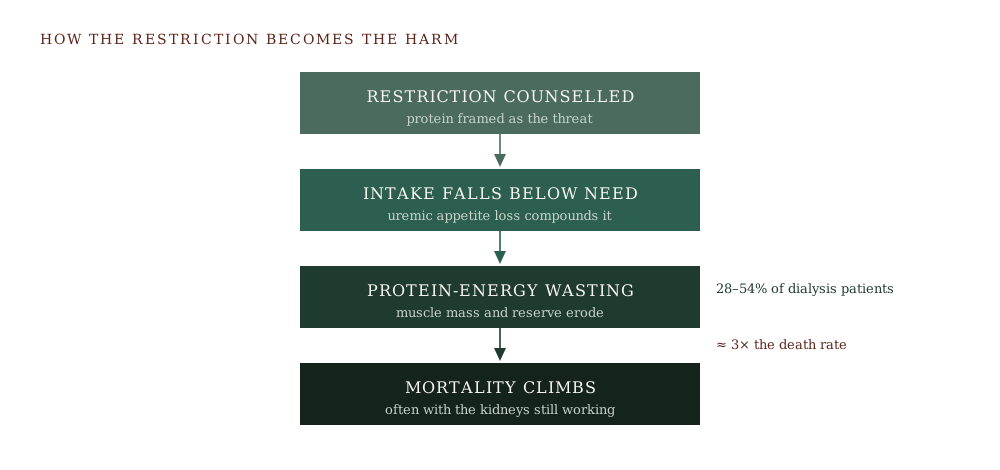
Many CKD patients die with their kidneys still functioning, of complications related to overall physiological decline. Cardiovascular events. Infections. Falls. The slow loss of resilience that comes with sarcopenia and frailty. The protein restriction that was supposed to protect their kidneys may have contributed substantially to the trajectory that ultimately killed them.
This is the side of the protein-restriction equation that conventional management has been slow to integrate. It is also the side that serious functional medicine has been working with for years, because the clinical experience of caring for CKD patients makes the trade-off impossible to ignore.
Quality and context, not just quantity
The conventional protein-restriction conversation collapses a complex clinical question into a single variable: grams per kilogram per day. The reality is considerably more nuanced, and the nuances matter.
The first nuance is that protein quality and source matter as much as quantity, and arguably more. The amino acid profile of the protein determines what is actually being delivered to the body — and to the kidney. Plant-based proteins, particularly when consumed in adequate variety to provide complete amino acid coverage, produce a different metabolic and inflammatory profile than animal-based proteins. The published literature on plant-based diets in CKD has been accumulating steadily for the past decade, with consistent signals that plant-protein-dominant patterns are associated with lower progression rates, better metabolic markers, and improved overall outcomes compared with animal-protein-dominant patterns at equivalent total protein intake. The mechanism likely involves reduced inflammatory load, lower acid load, improved gut microbiome composition, and the additional bioactive compounds that come bundled with plant proteins in their food matrix.
In my own clinical practice, plant-based protein is the primary recommendation for CKD patients across the spectrum. Legumes, lentils, tofu and tempeh, nuts and seeds, with strategic complementary patterns to ensure complete amino acid coverage. Animal protein is included where clinically appropriate but is not the foundation of the protocol. This is a defensible position from the contemporary literature and matches what serious renal nutrition is increasingly recommending in academic settings — the conventional restriction message has not yet caught up.
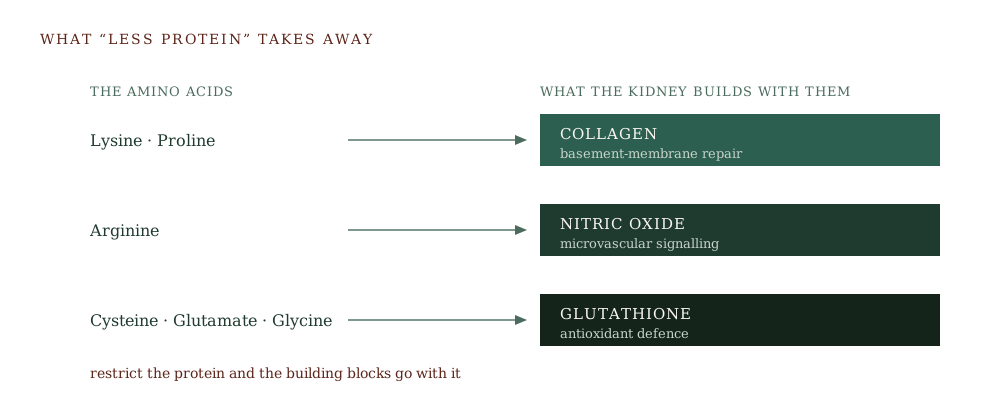
The second nuance is that specific amino acids matter. The kidney’s recovery depends on collagen synthesis at the basement membrane, which depends on adequate lysine and proline. It depends on nitric oxide signalling at the renal microvasculature, which depends on adequate arginine. It depends on glutathione synthesis for antioxidant defence, which depends on adequate cysteine, glutamic acid, and glycine. A patient who is told only less protein without attention to which amino acids are being lost is being deprived of the structural building blocks the kidney needs to recover. The previous article in this series — on kidney recovery — addressed this directly. The protocols that produce clinical improvement include adequate protein and specific amino acid support precisely because the kidney cannot recover without them.
The third nuance is that protein context matters. Protein consumed alongside a comprehensive renal-supportive protocol — vitamin C at therapeutic dose, the antioxidant stack, anti-inflammatory support, metabolic correction of dysglycemia and hypertension — places very different demands on the kidney than protein consumed in the context of unaddressed metabolic dysfunction. The patient with poorly controlled blood sugar, suppressed but not corrected hypertension, ongoing systemic inflammation, and inadequate antioxidant defence is producing a metabolic environment in which any protein intake creates more renal stress than necessary. The patient on a comprehensive functional medicine protocol is creating the opposite environment. The same gram of protein behaves clinically differently in those two contexts.
The conventional recommendation ignores all three of these nuances. It collapses the question to grams per kilogram, applies the answer uniformly across patients regardless of source, amino acid profile, or supporting clinical context, and produces a one-size-fits-all directive that does not match what serious clinical practice actually requires.
What the functional medicine approach actually does
The clinical position taken in serious functional medicine practice — and in my own work for over a decade — is that early-to-mid stage CKD patients require adequate protein intake, not restricted intake. Adequate, in this context, typically means 1.0 to 1.2 grams per kilogram of body weight per day, sometimes higher in patients with active recovery contexts, occasionally somewhat lower in patients with specific advanced-stage considerations. The exact number is calibrated to the individual patient’s stage, their underlying drivers, their muscle mass, their activity level, and their response over time.
This is paired with the renal-supportive protocol described in the previous article — the comprehensive nutritional, antioxidant, mitochondrial, and metabolic-correction work that addresses the actual drivers of CKD progression. The protein is not delivered in isolation. It is delivered as part of an integrated clinical strategy that supports the kidney’s recovery rather than depriving it of the substrate it needs.
The protein source, where possible, is plant-dominant. Patients are guided toward varied plant protein patterns that provide complete amino acid coverage — legumes paired with whole grains, the inclusion of soy products where culturally and individually appropriate, generous use of nuts and seeds, attention to specific amino acid needs through targeted supplementation where indicated.
For patients in advanced stages — Stage 4 and into Stage 5 — the conversation becomes more nuanced. Some elements of protein consideration become genuinely relevant at advanced stages, particularly around urea load management in patients with very limited remaining filtration capacity. But even here, the conventional aggressive restriction is rarely the right answer. The risk of accelerating PEW and the loss of physiological resilience usually outweighs the marginal benefit of additional protein restriction, and the appropriate clinical response is more sophisticated than less protein. It involves specific amino acid considerations, optimised protein quality, careful management of acid-base balance, and integration with the broader regenerative and metabolic-correction protocols that advanced-stage care requires.
Stage 5 patients on dialysis are a special case. Dialysis itself produces protein loss through the membrane, and these patients typically require higher protein intake than the general adult recommendation — often 1.2 to 1.4 grams per kilogram per day or more — to maintain protein status against the ongoing dialytic losses. The conventional restriction message, applied to dialysis patients, is particularly misaligned with what they actually need.
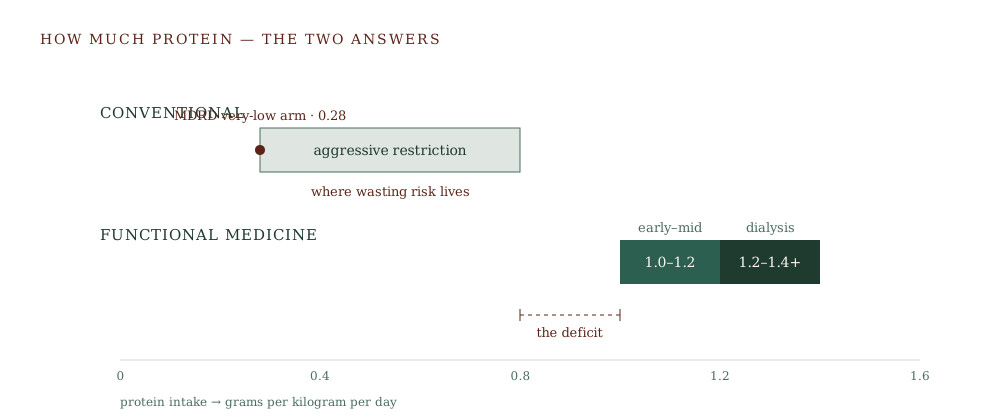
Across the spectrum, the principle is the same: adequate protein, quality-conscious, calibrated to the patient and their clinical context, paired with comprehensive renal-supportive care. This is what good clinical practice looks like. It is not what most patients have been told.
A closing argument
The standard protein-restriction recommendation in chronic kidney disease has persisted for decades on theoretical grounds while the trial evidence supporting it has remained weaker than the confidence with which it is delivered. The largest formal test — the MDRD study — failed to demonstrate clear benefit at its primary endpoint. The long-term follow-up of that same study found that the most aggressively restricted patients had higher mortality, not lower. Protein-energy wasting has emerged as one of the strongest predictors of death in CKD patients, with prevalence rates that should give pause to any clinician aggressively counselling restriction. And the clinical experience of practitioners who work closely with CKD patients across the disease spectrum has consistently pointed in the same direction: under-eating protein hurts these patients more than it helps.
Conventional nephrology is beginning to update. The most recent KDOQI nutritional guidelines have softened in places, and the renal nutrition literature is increasingly explicit about the risks of inadequate protein intake. But the message that reaches the actual patient — sitting in the actual nephrology clinic, hearing the actual instructions from their actual physician — has not yet caught up to where the science is. Most CKD patients, in 2026, are still being told to eat less protein, with limited guidance on quality, source, or context.
The functional medicine position is more demanding and more useful. Adequate protein, calibrated individually, plant-dominant where appropriate, paired with the renal-supportive clinical protocol that addresses the underlying drivers of disease. This requires more clinical work than the simple instruction to restrict. It also produces better outcomes — measured in biomarkers, in muscle mass, in physiological resilience, in the patient’s lived experience of their own body, and in the trajectory of their disease.
The patient who has been told to eat less protein deserves to know that the recommendation may be more harmful than helpful, that the evidence behind it is weaker than they were led to believe, and that the proper question is not how much protein to avoid but what kind of protein, in what context, paired with what supporting interventions, will actually help their kidneys recover.
The answer to that question is not on a standard nephrology guideline document. It is in a clinical conversation with a practitioner trained to do the work properly. That, again, is the conversation worth having — and the conversation that this entire series has been arguing the patient deserves.
The protein restriction was never the protection. The protein restriction was, for many patients, part of the harm. Knowing the difference is the first step toward a different trajectory.