There is a common scene in clinical practice. A patient comes in, hands over a recent blood panel, and explains that their family doctor put them on vitamin D. Specifically, on a 50,000 IU capsule taken once a month. Sometimes weekly. The patient has been on this regimen for six months, a year, sometimes longer. They feel no different. Their energy has not changed. Their mood has not lifted. Their sleep is the same.
When their serum 25-hydroxyvitamin D is rechecked, the number has often barely moved.
This is not unusual. It is the predictable result of a dosing strategy that was never designed for the outcome the patient was hoping for. The monthly bolus capsule is one of the most widely prescribed nutritional interventions in modern primary care. It is also one of the most pharmacokinetically misjudged.
This article makes a specific argument: that high-dose intermittent vitamin D — weekly 25,000 IU, monthly 50,000 IU, the standard prescriptions issued by family doctors and clinics around the world — is the wrong tool for ongoing vitamin D maintenance. The mechanism explains why. The trial data supports it. And the conventional practice of treating monthly bolus as a long-term solution is not supported by either the pharmacokinetics of vitamin D or the outcome data we now have.
This is not an argument against vitamin D. It is an argument about how vitamin D should be dosed for it to actually work.
What the conventional protocol assumes
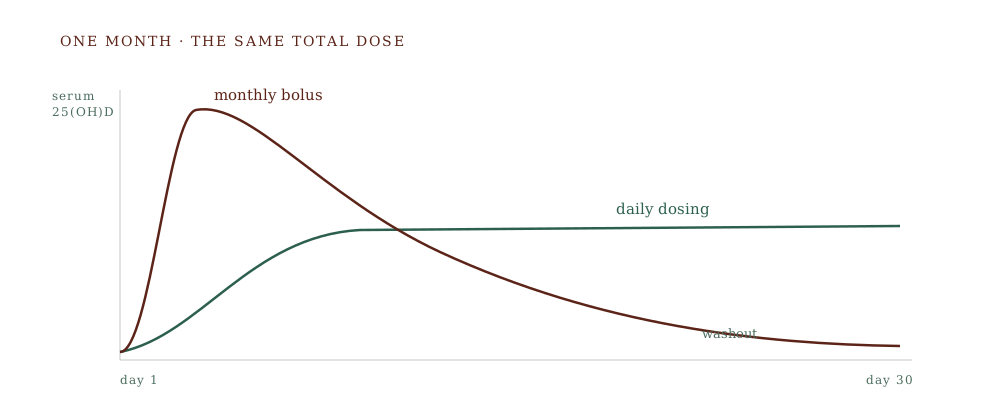
The conventional bolus protocol rests on a simple assumption: vitamin D is a fat-soluble vitamin, the body can store it, and therefore a large dose given infrequently should produce roughly the same physiological effect as a smaller dose given consistently. The total monthly intake is similar. The serum 25(OH)D measurement, taken at the right interval, often looks acceptable. The protocol is convenient — patients who cannot remember a daily pill can manage a monthly clinic visit.
For the institution, this is logistically efficient. For the patient, it is what they are told to do. For neither party is the question usually asked: does the body actually use vitamin D the way this protocol assumes?
The answer, when you look at the pharmacokinetics carefully, is no.
What actually happens when you take a 50,000 IU bolus
When a large oral dose of vitamin D3 enters the bloodstream, serum 25(OH)D rises sharply over the following days. The lab test, drawn a few weeks later, often shows a satisfying number. The institutional reading is that the protocol is working.
What the lab number does not show is what is happening at the tissue level — and this is where the conventional model breaks.
The body responds to a sharp rise in 25(OH)D the way any tightly regulated biological system responds to a perceived overshoot: it increases the rate of clearance. The relevant enzyme is 24-hydroxylase, encoded by the CYP24A1 gene. Its job is to inactivate vitamin D metabolites by converting them into water-soluble forms that the body can excrete. Under normal conditions, this enzyme runs at a baseline level. Under bolus conditions, its activity is upregulated significantly. The body, sensing what it interprets as a large nutrient surge, accelerates its disposal mechanism.
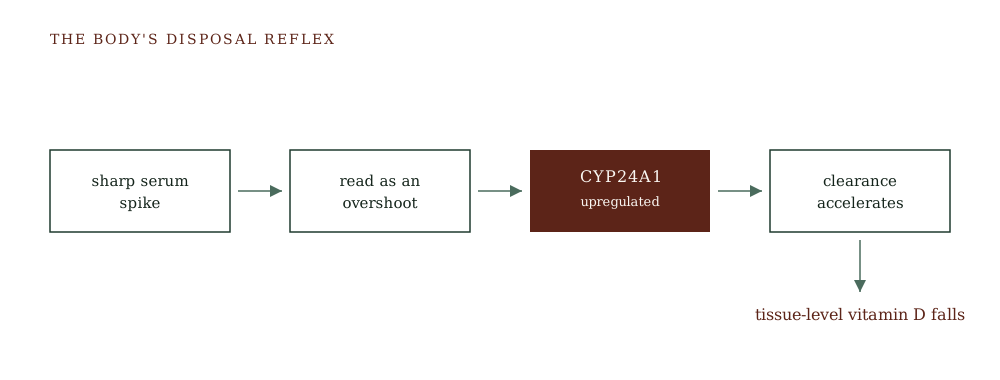
The consequence is mechanistically uncomfortable for the conventional model. In the weeks after a bolus, the active vitamin D metabolites available at the tissue level — where vitamin D actually does its work, on immune cells, in bone, in the brain, in the cardiovascular system — may be lower than they would have been on consistent daily dosing of an equivalent total amount. The serum number goes up. The biological availability, paradoxically, goes down.
There is a second problem that compounds the first. Vitamin D3 is fat-soluble, and a bolus dose does not stay in active circulation. It sequesters into adipose tissue, where its bioavailability for ongoing tissue effects becomes unpredictable and highly patient-specific. Patients with higher adiposity — which includes most patients with the chronic conditions vitamin D is being prescribed to address — sequester more, release less, and end up with a substantial fraction of the prescribed dose effectively warehoused in body fat rather than working in the bloodstream.
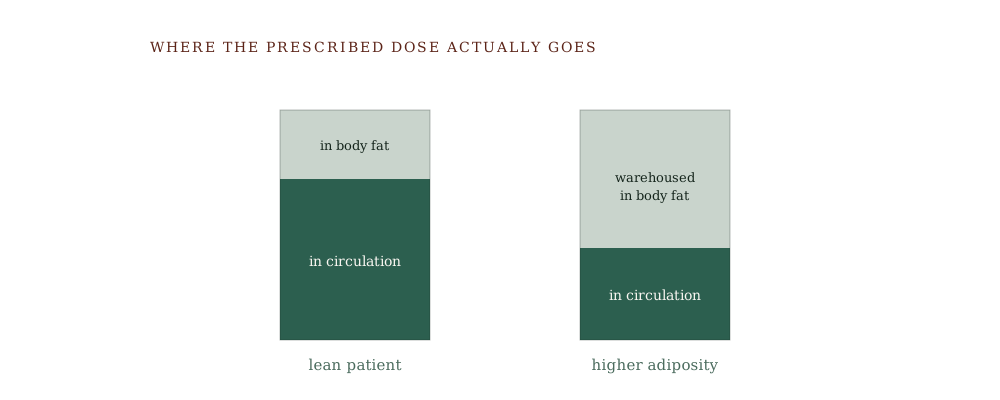
The combination of these two mechanisms produces a clinical situation that the conventional reading of the lab result does not capture. The patient’s serum 25(OH)D may look adequate at follow-up. Their tissue-level vitamin D activity may be substantially lower than the lab number suggests. The patient’s clinical experience — no improvement in mood, immunity, energy, or whatever indication the vitamin D was prescribed for — is consistent with this mechanistic picture, even when the lab number is not.
What the trial data shows
This is not purely a mechanistic argument. There is published trial-level evidence that high-dose intermittent vitamin D produces worse outcomes than the conventional model would predict — and in specific populations, signals of outright harm.
The most cited example is Sanders and colleagues, published in JAMA in 2010. The study gave elderly women a single annual dose of 500,000 IU oral cholecalciferol, on the assumption that an annual dose with the same total intake as daily supplementation would deliver equivalent benefit. The result was the opposite of what the protocol assumed. The high-dose group showed increased rates of falls and fractures compared to placebo. The total amount of vitamin D was reasonable; the way it was delivered was harmful.
A similar pattern appeared in Smith and colleagues, published in Rheumatology in 2007, using annual 300,000 IU intramuscular cholecalciferol — again, increased fracture risk in the bolus group.
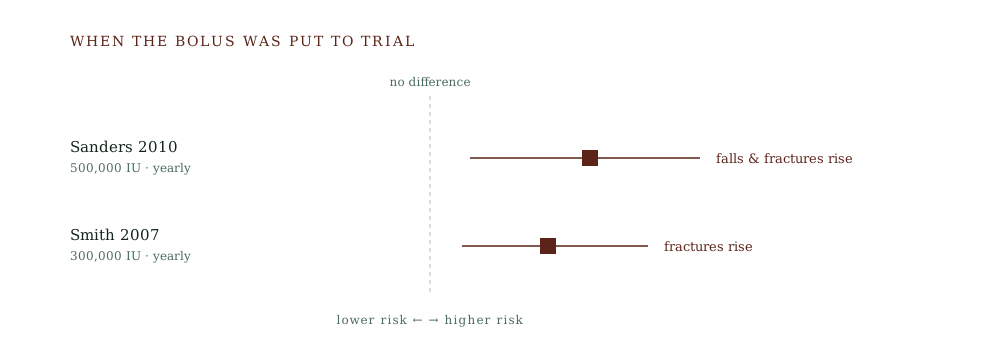
These trials do not say that vitamin D is harmful. They say that very large boluses, given infrequently, produce physiological responses that differ from steady-state vitamin D status — and that those responses, in some populations, increase the risk of exactly the outcomes the protocol was meant to prevent. The CYP24A1 upregulation is the leading mechanistic explanation for why this happens.
The clinical literature has accumulated enough of this signal that the conventional bolus approach can no longer be defended as obviously equivalent to daily dosing. The two protocols produce different physiological states. They are not interchangeable. Treating them as if they are is a methodological error that has now been documented at trial level.
Where bolus dosing legitimately belongs
It is worth being precise here, because the argument is not that bolus dosing is always wrong. It is that bolus dosing has a narrow legitimate role that conventional practice has expanded far beyond its evidentiary basis.
The legitimate role is time-bound deficiency correction. A patient presenting with a serum 25(OH)D of 12 ng/mL — significantly deficient, with measurable clinical consequences — needs that level brought up quickly. A short loading phase of 50,000 IU weekly for eight to twelve weeks is a reasonable approach to that specific clinical task. It is supervised, time-limited, has a defined endpoint (a target serum level), and is followed by transition to a different maintenance protocol.
This is appropriate Tier 4a use. The dose, frequency, duration, and monitoring all align with the clinical goal of correcting an established deficiency.
The error is what happens after the loading phase ends — and in many primary care settings, the error happens because there is no transition. The bolus protocol becomes the maintenance protocol. The patient continues on monthly 50,000 IU not because the pharmacokinetics support it but because the protocol that worked for loading was simply continued, indefinitely, without anyone asking whether it was the right tool for the new clinical question.
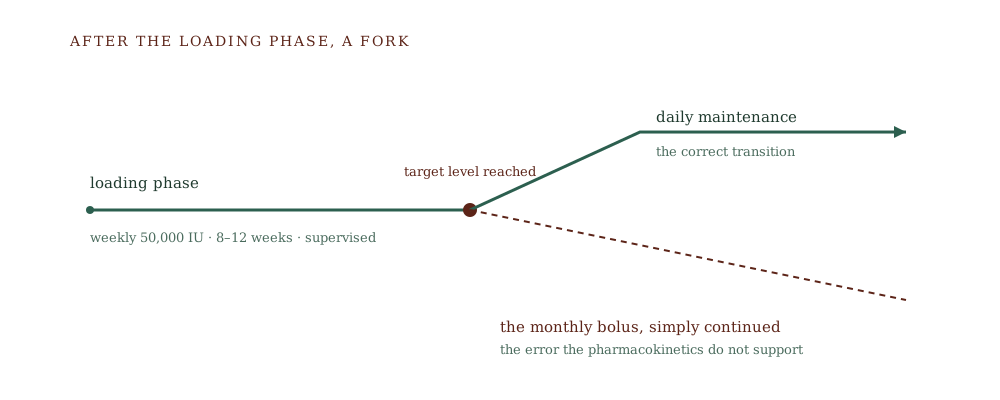
Loading and maintenance are different clinical questions. They require different protocols. The conventional model has blurred this distinction, and the result is millions of patients worldwide on a long-term regimen that the underlying pharmacokinetics do not support and that the trial data — in some populations — actively contradicts.
Why this happens
The bolus protocol is not a clinical decision made on the basis of pharmacokinetic optimisation. It is an institutional decision made on the basis of patient compliance management. A patient who cannot remember to take a daily pill can be reliably given a monthly capsule under direct observation in clinic. The compliance problem is solved. The pharmacokinetic problem is not even raised.
This is not malice. It is not even negligence in the legal sense. It is what happens when a complex molecule with specific pharmacokinetic requirements gets folded into a healthcare delivery model designed to optimise for visit frequency, prescription efficiency, and adherence-tracking simplicity. The dose was calibrated to the institutional logistics, not to the molecule.
This is the same pattern the foundation of this argument has identified across nutritional medicine more broadly — the dose on the bottle, or in the clinic, was rarely calibrated to physiology. It was calibrated to whatever was easier to administer. Vitamin D is one of the cleanest examples of how that institutional convenience produces a clinical practice that does not actually achieve what it was prescribed for.
What the patient on monthly bolus should consider
If you are currently on weekly 25,000 IU or monthly 50,000 IU vitamin D and have been for some time, the practical question is not whether to stop. The practical question is whether your current regimen is still answering the clinical goal it was originally prescribed for.
A few considerations worth raising with a clinician trained in nutritional medicine:
Has your serum 25(OH)D actually responded over time? Not just the post-loading number, but the trajectory across multiple measurements. Some patients on long-term bolus protocols show stable serum levels that obscure declining tissue availability. Others show no real improvement at all despite years of monthly dosing.
Are you experiencing the clinical benefits the protocol was meant to deliver? If the prescription was for energy, mood, immune function, or skeletal protection, has any of that actually shifted? A long-running protocol with no measurable clinical change is a protocol that needs questioning, regardless of what the lab number says.
Is your dose form and timing matched to the goal? For maintenance, daily dosing keeps the molecule in active circulation, avoids the CYP24A1 upregulation that bolus dosing triggers, and produces tissue-level vitamin D activity that more reliably matches the serum measurement.
Are the cofactors that vitamin D depends on present in your protocol? This is the question that often goes unasked entirely in conventional practice. Vitamin D does not work alone. The activation pathway depends on magnesium. The downstream calcium handling depends on vitamin K2. A vitamin D protocol that addresses none of these cofactors is delivering a fraction of what the molecule could do, and in some patients can produce calcium-handling consequences that get wrongly attributed to vitamin D itself. This is its own article — and the next one in this series. For now, it is enough to know that vitamin D dosing without cofactor consideration is incomplete clinical work, regardless of the dose or schedule.
These are not questions for self-management. They are questions for a clinician who understands the pharmacokinetics, can interpret the bloodwork properly, and can design a protocol calibrated to the patient rather than to institutional convenience.
A closing argument
The story of the monthly vitamin D bolus is a small, specific instance of a much larger pattern. A patentable molecule would never be approved on the assumption that an annual dose produces the same physiological effect as daily dosing. The pharmacokinetics would be studied in detail; the dose-response relationship would be characterised; the maintenance protocol would be specifically validated. None of this is unusual or controversial in pharmaceutical development.
A public-domain nutrient does not get this treatment. The protocol is set by institutional convenience, the lab number is read uncritically, and the patient is told that they are on vitamin D — without anyone asking whether the way they are taking vitamin D is actually delivering what vitamin D can deliver.
This is not a critique of doctors. The institutional protocols are what they are; clinicians follow them in good faith. It is a critique of how a specific class of clinical decisions — nutrient dosing, schedule, and maintenance — has been left to logistical defaults rather than pharmacokinetic principles. The cost of that default is borne by patients who take their monthly capsule for years, dutifully, and never quite get the benefit they were told they would.
If your monthly vitamin D capsule has not delivered what it promised, the problem is probably not vitamin D. The problem is probably the schedule. And the conversation worth having is with a clinician who can read the pharmacokinetics, the cofactors, and your specific physiology — and design a protocol that actually matches what you were trying to achieve.
That is what nutritional medicine, properly practised, does. That is what the institutional shortcut cannot.