Ask five well-read people whether fish oil is good for your heart and you can collect five confident answers, each citing trials, each contradicting the others — because the trials really do contradict each other on the surface. One of the largest ever run found nothing. Another found a striking benefit. A third, using the same dose as the second, found nothing again and was stopped early for futility. Faced with that, most people either throw up their hands or quietly keep the study that agreed with them. There is a third option, and it is the whole point of this essay: read the trials apart, one variable at a time, until the contradiction turns out not to be one.
This is a companion to a method I have laid out separately — the questions to ask of any health claim — and it is the hardest worked example I know, because omega-3 is not a case of good evidence against bad evidence. It is a case of good evidence against good evidence, where large and careful trials genuinely point in different directions, and the only way through is to stop asking the useless question — does fish oil work? — and start asking the useful ones. Five of them: at what dose, in what molecular form, in whom, against what comparator, measured by what endpoint. Answer those, and the mess resolves into something you can actually stand on.
The contradiction, laid out
Here are the trials that create the apparent chaos, stated plainly.
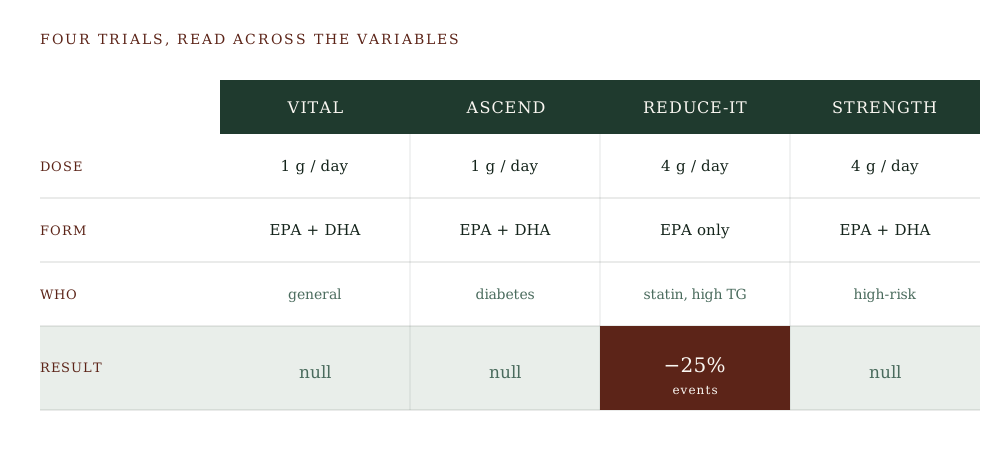
Two very large trials tested fish oil at the dose most people actually take — around one gram a day. One followed nearly twenty-six thousand people (the VITAL trial); the other, some fifteen thousand people with diabetes (ASCEND). Both measured hard cardiovascular outcomes, and both were, for their main question, null: no significant reduction in the combined cardiovascular endpoint. Then a third trial (REDUCE-IT) tested a much higher dose — four grams a day — of a purified form of one omega-3, in a selected high-risk population, and reported a striking result: roughly a quarter fewer major cardiovascular events. And then a fourth trial (STRENGTH) tested the same four-gram dose in a similar high-risk population, using a slightly different preparation, and found nothing at all — it was stopped early because it was never going to show benefit.
Set those side by side and it looks like the literature is at war with itself: null, null, big positive, null again, with the positive and one of the nulls run at the identical dose. If you want to sell fish oil you quote the positive one and stop. If you want to dismiss it you quote the nulls and stop. Both are choosing the ending. The honest reader does something slower.
Variable one — dose
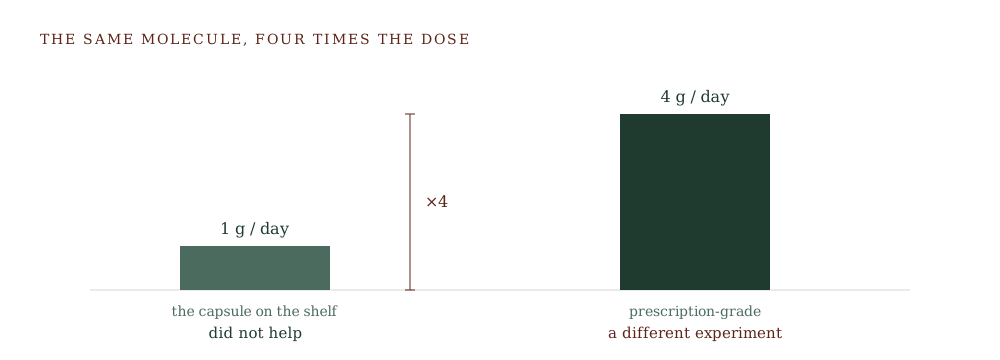
The first cut is the simplest and it removes half the confusion immediately. The two big null trials used about one gram a day. The positive trial used four. These are not the same intervention with a different label on it; four grams of concentrated omega-3 is to a one-gram capsule roughly what a prescription is to a mouthful, and it is not surprising that they behave differently.
This matters enormously for what you should take from the literature, because the dose that failed is the dose almost everyone actually swallows. The capsule on the pharmacy shelf, the one your relative takes for their heart, is a one-gram dose or less — the dose tested in the two large trials that found no benefit for hard endpoints. So the single most representative finding, the one that speaks to what most people are actually doing, is the null one. Before any of the subtlety that follows, that plain fact deserves to sit in the open: at the dose people take, in the biggest trials, for the outcomes that matter, fish oil did not help.
Variable two — form
That leaves the interesting question, which is why the four-gram trials disagreed with each other. Same dose, opposite result — this is the pair that a serious reader has to explain, and the first candidate explanation is molecular form.
The positive trial used a purified preparation of a single omega-3, EPA, and nothing else. The null four-gram trial used a preparation combining EPA with a second omega-3, DHA. So one available reading is that purified EPA does something that the EPA-plus-DHA combination does not — that the active agent is specifically EPA, and adding DHA blunts or cancels the effect. This is a real and much-discussed hypothesis, and it may be part of the answer. But it cannot be the whole answer, and the reason it cannot is the next variable, which is the one most people never reach.
Variable three — the comparator
Here is where reading honestly stops being comfortable, because the most important difference between the two four-gram trials may not be the drug at all. It may be the placebo.
A trial does not measure a treatment in isolation; it measures the treatment against whatever the control group received, and reports the gap between them. The positive four-gram trial used mineral oil as its placebo. The null one used corn oil. And in the positive trial, the mineral-oil placebo group did not simply stay put — over the trial their LDL cholesterol and their markers of inflammation drifted upward. If the comparison group quietly got a little worse, then the gap between the treatment and the control is not purely the treatment getting the patients better; it is partly the control getting worse, and some of the headline benefit could be an artifact of an imperfect placebo rather than an effect of the drug. Most people who have examined this closely judge that the confound is too small to erase the whole result — the effect is probably real — but it is large enough that the positive trial should be read as a contested positive, not a settled one. The same four grams of EPA, measured against a cleaner comparator, might have looked less impressive. We do not get to know by how much.
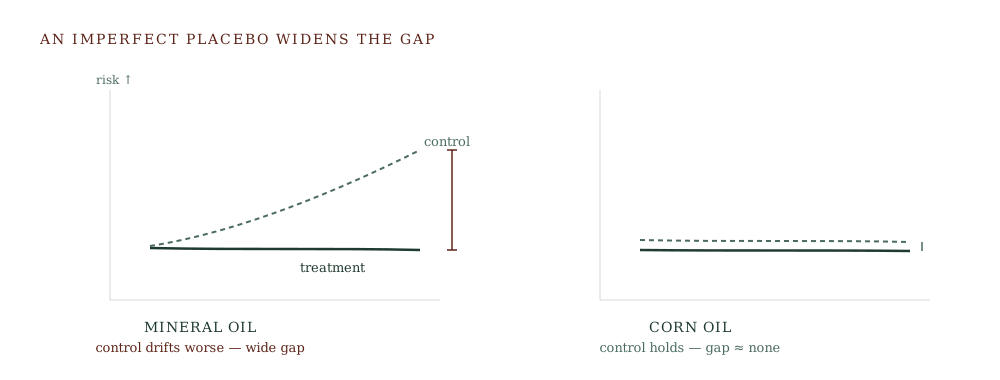
Notice what has happened to the tidy “it must be EPA” story. The two four-gram trials differ in the drug and in the placebo at the same time, which means their opposite results cannot be cleanly assigned to either one. That is not a failure of the evidence. It is the actual state of the evidence, and pretending it is cleaner than that is how people end up confidently wrong.
Variable four — baseline
There is a fourth variable that quietly shapes all of this, and it is the state of the person before the trial began. An intervention that corrects a deficiency behaves very differently from the same intervention added to someone who already has plenty.
The clearest hint comes from an older trial in Japan (JELIS), which found a benefit from EPA added to standard treatment — but it was run in a population with among the highest habitual fish intake in the world, and it was not blinded in the way the later trials were. Whatever it shows, it shows it in a context very unlike a Western supplement-taker. And that is the point about baseline: most people in the countries where fish-oil capsules sell best are not omega-3 deficient in any clinical sense, and topping up a level that is already adequate is not the same experiment as raising a level that is genuinely low. A supplement that does something for the depleted can do nothing for the replete, and the average buyer of a capsule is closer to the second than the first.
Variable five — the endpoint
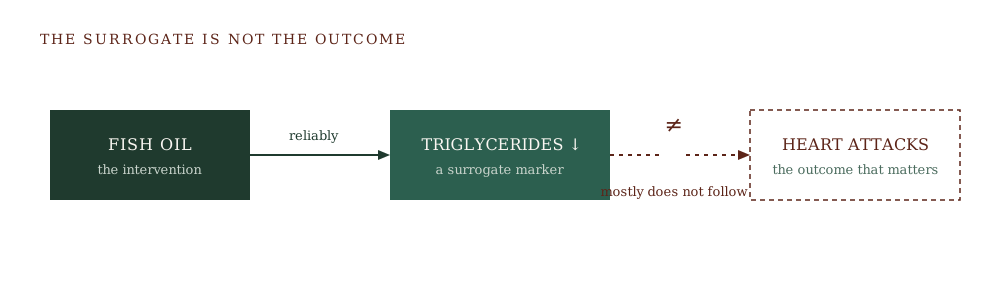
The last variable is the one the companion essay dwells on, and it catches more omega-3 claims than any other: the difference between an outcome that matters and a surrogate that merely travels alongside it.
Fish oil reliably lowers triglycerides — a real effect, and the basis of a great many “clinically proven” claims, proven only to move a number in the blood. But triglycerides are a surrogate, a marker that correlates with cardiovascular risk without being the risk, and the entire question this essay is circling is whether moving that marker with these agents actually prevents the heart attacks the marker is standing in for. At supplement doses, in the large trials, it mostly did not. A claim that fish oil “improves your cholesterol profile” or “lowers your triglycerides” can be perfectly true and still tell you nothing about whether it will keep you out of hospital, and the slide from the surrogate to the implied outcome is exactly where the marketing lives.
The harm the pitch never mentions
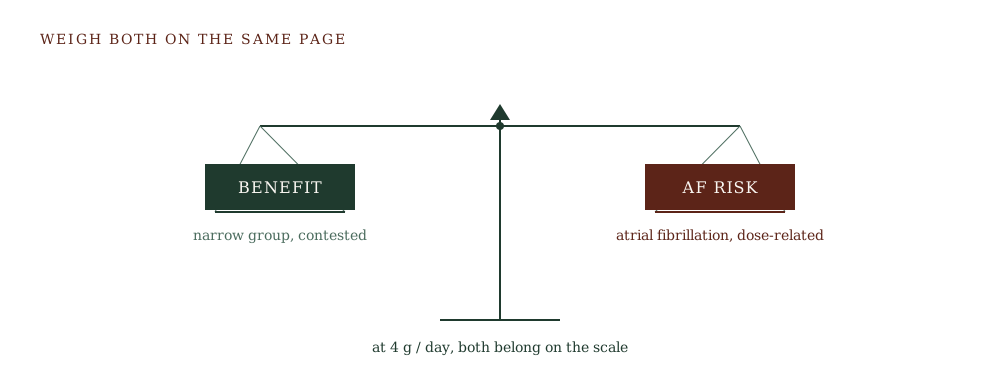
Before the synthesis, one fact that belongs on the same page as every benefit and is almost never printed there: high-dose omega-3 increases the risk of atrial fibrillation, a heart-rhythm disturbance that itself raises the risk of stroke. The excess appeared in both four-gram trials — the positive one and the null one — and has been confirmed when their data and others are pooled. This is not a fringe worry or a rounding error; it is a real, dose-related harm from the same high doses that carry whatever benefit exists. An honest account cannot put the possible benefit on a poster and leave the harm in a footnote, which is precisely what a supplement advertisement does. If you are weighing four grams a day, the atrial-fibrillation risk is part of the weighing, not an asterisk beneath it.
What this adds up to
Read apart, the contradiction is gone, and what remains is a set of conditional statements that are less quotable than either slogan and far more useful.
For most people, at the roughly one-gram dose they actually take, fish oil did not reduce the primary composite of major cardiovascular events — the largest and most representative trials say so, and that is the finding that applies to the capsule on the shelf. There are scattered secondary signals — one of the big trials showed fewer heart attacks on a secondary count — but a positive secondary endpoint does not rescue a null primary, and reading a trial by the question it was built to answer is the whole discipline here. A four-gram dose of purified EPA may reduce events in a specific and narrow group — patients already on a statin, with high triglycerides and high cardiovascular risk — but that single positive trial is contested by its own placebo, it is not the same as the null four-gram trial that used a different preparation and comparator, and it carries a real risk of atrial fibrillation that scales with the dose. None of that is an argument for the general population to take an over-the-counter capsule for “heart health,” and the whole rhetorical trick of the category is to blur the line between a four-gram prescription-grade drug given to a defined high-risk patient and a one-gram supermarket capsule taken by someone well. Those are different interventions in different people for different reasons, and only one of them has a serious case behind it.
And a separate point that the capsule debate tends to bury: eating oily fish is not the same question as swallowing fish oil, and the case for fish as food — a few times a week, as part of a diet — rests on different and broadly reasonable evidence. The failure of the capsule is not an indictment of the salmon.
What would change my mind
Each strand of this could move, and it is worth being specific about how.
If a new trial gave four grams of purified EPA against a genuinely inert placebo — not mineral oil — and reproduced the benefit, the contested positive would become a much firmer one, and the comparator objection I have leaned on would fall away. If, on the other hand, larger and longer data made the atrial-fibrillation signal grow rather than settle, the risk side of the ledger would get heavier and the narrow group for whom four grams is worth it would get narrower still. And if a well-designed trial gave a modest dose to people who were genuinely omega-3 deficient at baseline — the experiment that has mostly not been done — and found a clear benefit, then the “supplement doses do nothing” conclusion would need an exception carved into it for the depleted. None of these has happened yet. When one does, the conclusion should move exactly as far as the new evidence licenses and not a step further, which is the discipline this whole essay is trying to model.
A closing argument
The reason omega-3 is worth this much patience is not that the answer is thrilling — it plainly is not — but that the shape of the reasoning is the transferable thing. “Fish oil works” and “fish oil is a scam” are both the sound of someone who has stopped reading and picked a side. The real answer is not a verdict; it is a set of conditions — this dose, this form, this population, this comparator, this endpoint, this harm — and every one of them changes what the same molecule does. Anyone with a bottle to sell has a direct interest in collapsing those conditions into a single confident sentence, because a slogan sells and a set of conditions does not.
Holding the conditions apart is the entire skill, and it is not a skill reserved for people with medical degrees. It is just the refusal to let a complicated truth be simplified into whichever slogan someone profits from. The omega-3 literature happens to be the messiest case I know for practising it, which is exactly why it is worth practising on. If you can read these trials without either buying the capsule or dismissing the fish, you can read almost anything.