Your results come back and everything is normal — every value inside its reference range, a tidy column of ticks. And yet one of two things is often true. Either you feel unwell and were told, on the strength of that column, that there is nothing wrong; or someone has told you the opposite — that your normal is secretly suboptimal, that the ranges are too loose, and that the fix is a panel of further tests and a shelf of supplements. Two answers cluster around the same gap between what a lab calls normal and what it feels like to be well — one that shrugs it off, the other that sells into it. This essay is about what a reference range actually is, and how to tell the few places where normal genuinely is not good enough from the many where optimal is being invented to sell you something.
I have to be even-handed in a way that will annoy both sides, because the honest position sits between a careless dismissal and a dishonest sell. The conventional dismissal — your labs are normal, therefore nothing is wrong — mistakes a statement about a population for a statement about you. The alternative-medicine sell — your labs are normal but not optimal, therefore buy this — takes a real idea and turns it into a machine for making healthy people into customers. Both are wrong, and they are wrong about the same thing: what the word normal on your report actually means.
What a reference range actually is
Here is the whole misunderstanding, and it is worth getting exactly right. A reference range is not a boundary between health and disease. It is a description of a population. When a laboratory establishes the reference range for a marker, it measures that marker in a sample of reference people — usually people considered healthy — and then draws the range to contain the central ninety-five per cent of them. The lines you see, the “normal” bounds, are simply the points below which the lowest two and a half per cent fall and above which the highest two and a half per cent fall.
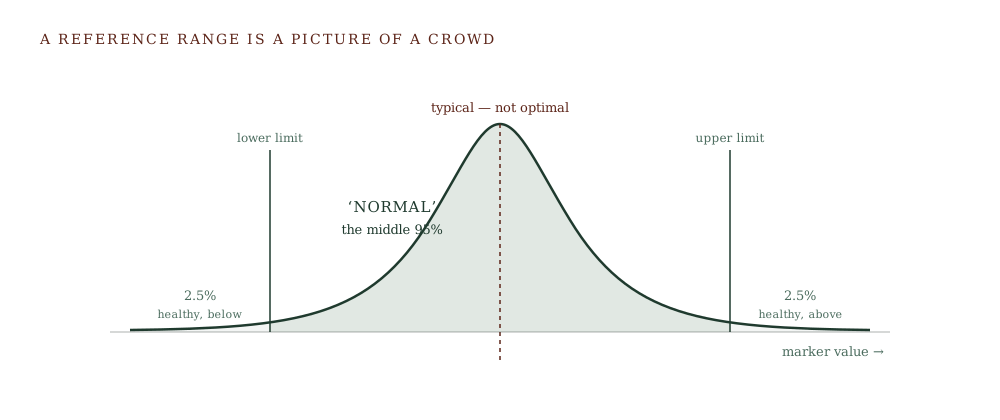
Two consequences follow, and neither is intuitive. The first: by the very way the range is built, two and a half per cent of perfectly healthy people fall below the bottom line and two and a half per cent above the top one — not because anything is wrong with them, but because that is where the statistics put the edges. Being just outside the range is not automatically abnormal, and being just inside it is not automatically fine. The second, and more important: the range describes whoever was in the reference sample. It tells you what is typical of that crowd. It does not tell you what is optimal for a human being, because typical and optimal are different questions, and a population can be typically unwell. In a population where a quarter of adults have fat in the liver, “normal” liver enzymes are the enzymes of a population a quarter of whom have fatty liver. Normal means usual. It does not mean good, and it was never designed to — which is exactly the true premise the sell is built on.
So the alternative-medicine slogan has a true premise. Normal is genuinely not the same as optimal. The trouble is everything that gets built on top of that true premise — because “normal is not optimal” is also the exact sentence used to sell you things, and the premise being true does not make the sale honest. The work is separating the places where a target tighter than normal is real from the places where it is invented, and for that you need a rule.
Where normal genuinely is not good enough
Start with the real cases, because they exist and they matter, and pretending they do not is the conventional error.
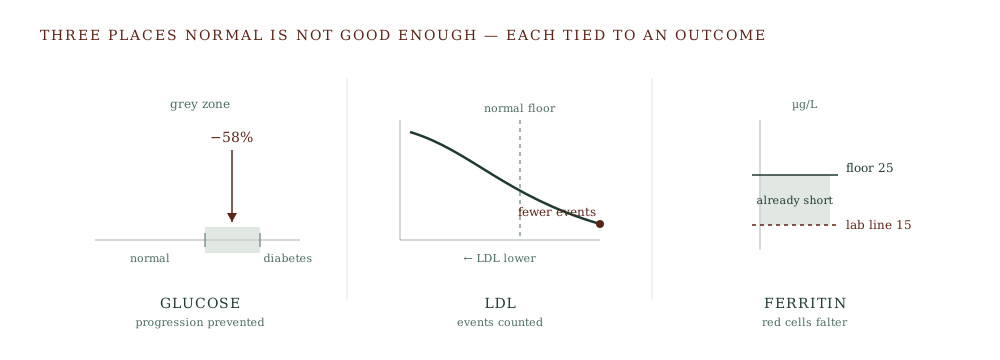
Consider blood glucose. There is a zone — call it prediabetes — where the marker is above optimal but below the threshold that would earn a diagnosis of diabetes. The conventional reading treats that zone as a waiting room: not yet diseased, nothing to do, come back when you cross the line. But that reading is wrong, and we know it is wrong because of what happens when you act. In people sitting in exactly that grey zone, an intensive lifestyle intervention reduced the progression to type 2 diabetes by fifty-eight per cent. A target tighter than the disease threshold is therefore not an invention here; it is warranted, because acting at the tighter target changes what happens to the person. The grey zone is real, and it is narrow, and it is defined by an outcome.
Consider LDL cholesterol. For this marker, read as a target, the reference range positively misleads, because “lower is better” holds well past the bottom of what a lab calls normal. Across large bodies of trial evidence, each reduction of roughly one unit of LDL brings down major vascular events by around a fifth, and trials that drove LDL far below the normal range — adding a second drug on top of a statin, or a newer agent that pushes it lower still — kept reducing events as they went. Here the optimal target is genuinely and substantially lower than the reference range, and it is not a matter of opinion or percentile: it is anchored to counted heart attacks and strokes.
Consider ferritin, the marker of iron stores, which is the honest middle case. The level below which the body starts to run short of iron for making red blood cells sits above the low end of the conventional reference range — physiological work puts that floor for women near 25 micrograms per litre, against a lab cutoff of 15 — so a ferritin that the lab reports as normal, at the bottom of its range, can already be a level at which iron-deficient red-cell production has begun. This is a real floor, derived from what actually happens to the blood at that level. It is also, and this matters for later, an evidence-derived floor and not a licence: the fact that the true floor is higher than the lab’s does not mean that more ferritin is always better, or that some round “optimal” number pulled from the air is a target worth chasing.
Three markers, three places where normal is not good enough — and notice what they have in common. In each case, the tighter target is not asserted; it is tied to something that happens. Diabetes prevented. Heart attacks counted. Red-cell production failing. That common feature is not a coincidence. It is the rule.
The gate
Here is the rule, stated plainly, because it is the load-bearing sentence of the essay: a target tighter than the reference range earns its place only when acting to reach that specific level has been shown to improve a specific health outcome — and never merely because the level reflects where a population sits, correlates with some marker, or has a product waiting to move you toward it. The one narrow exception is a physiological floor like ferritin, where the level marks a demonstrated functional deficit — red-cell production actually faltering — rather than a plausible mechanism; and even then the burden is a shown deficit, not a story about one.
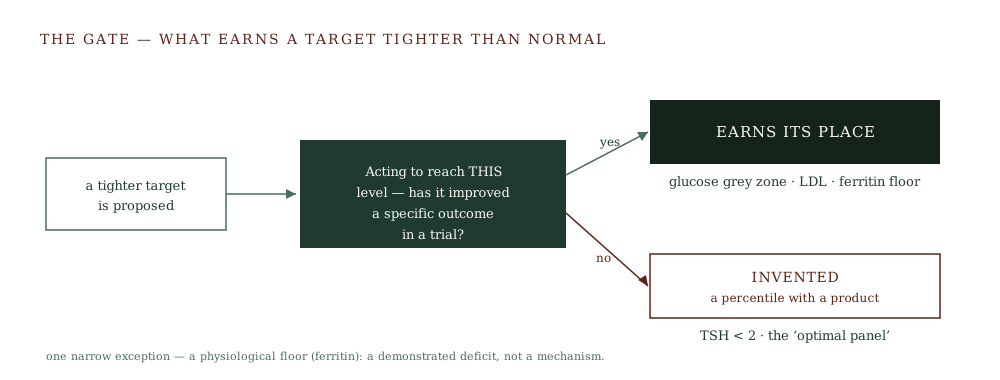
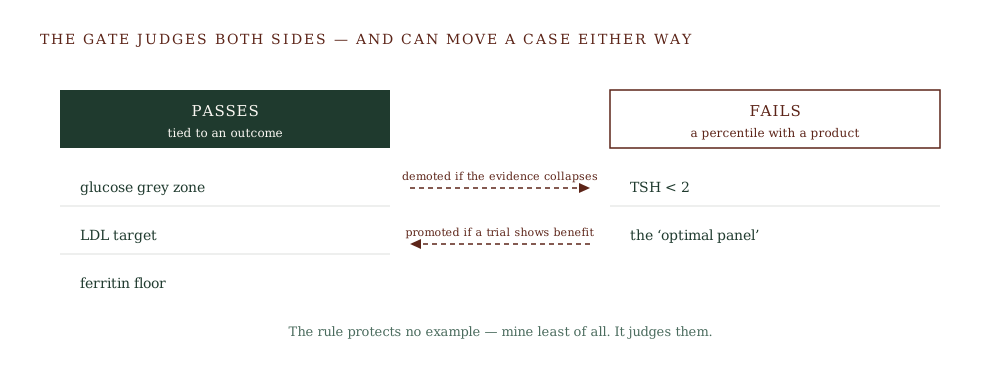
The glucose grey zone passes the gate: intervene at that level and progression falls. LDL passes: lower the number and events fall. The ferritin floor passes: reach that level and red-cell production suffers. Each is a number tied to an outcome by a study that could, in principle, have come out the other way. That last clause is what makes the rule a rule and not a preference. It is falsifiable. And — this is the part that matters — it is not automatically kind to my own side of medicine. Applied honestly, it disqualifies a great deal of what functional medicine likes to call optimal, and the honesty of the whole essay depends on my applying it there too.
Where optimal is invented
So let me apply it there. The phrase optimal range is, unfortunately, the single most useful tool in the kit of the practitioner who wants to convert a healthy person into a patient, because it lets you look at an entirely normal result and say, with a concerned expression, that it is not optimal — and then sell the tests and supplements that will address the deficiency you have just manufactured. Run the gate over the two commonest versions and watch them fail.
The first is the claim, repeated everywhere in the wellness world, that your thyroid marker TSH must be under a particular tight number — two, usually — regardless of the laboratory range. Run the gate. Is that specific target tied to an outcome? It is not. The upper limit of a genuinely healthy TSH rises with age — older people sit higher and are not thereby ill — so a single tight cutoff applied to everyone reclassifies a large number of healthy older people as hypothyroid. And where treating a raised TSH has actually been tested — in older adults with subclinical elevations sitting well above the lab line, the group those trials enrolled — thyroid hormone did not make patients feel or function better. There is no trial showing benefit even at those higher levels, let alone in the barely-above-two group that a target of two actually reclassifies. The number fails the gate twice over: it is a population percentile masquerading as a target, and acting on it does not improve outcomes. It is exactly the kind of invented optimal the rule exists to catch.
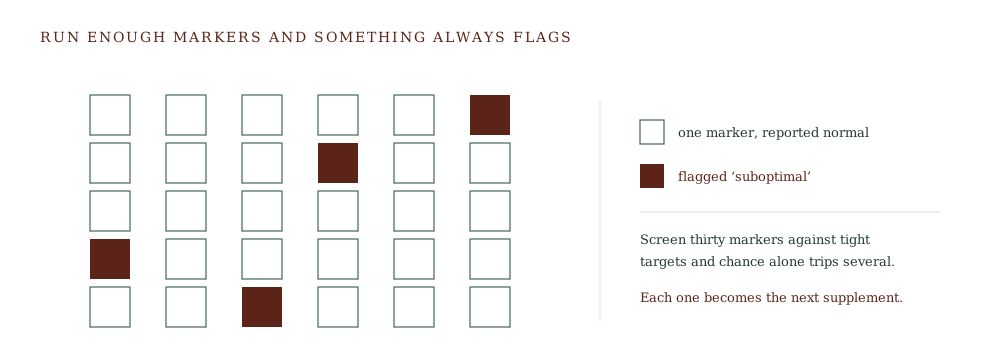
The second is the whole-body “optimal panel” — the broad screen returned with tighter-than-reference targets printed against dozens of markers at once, most of them nothing more than population percentiles relabelled as optimal, with no outcome study behind a single one. Its function is structural: run enough markers with tight enough targets and you will always find something “suboptimal,” because that is what the mathematics of many tests guarantees, and each flagged marker becomes a reason for the next supplement. It is a machine for manufacturing abnormality, dressed in the language of thoroughness. Almost none of it survives the gate.
I want to be plain about what this means, because it is the concession the industry using these words never makes. Most of what gets sold as “your optimal ranges” does not pass the test I have just described. The idea that normal is not the same as optimal is true; the overwhelming majority of specific “optimal” numbers attached to that idea are not earned. Both of those statements are mine, and they have to be held together, or I am just another person using a true premise to sell an unproven conclusion.
Two distinctions that keep it honest
Two further distinctions do the quiet work of keeping the real cases from being turned back into a sales pipeline.
The first: a warranted tighter target is not the same as a reason to take a supplement. These are two separate steps, and the sell depends on gluing them together. That the glucose grey zone is real and actionable does not mean the action is a pill — it is, first and overwhelmingly, the diet and activity that the trial actually tested. That a ferritin floor is real does not mean the answer is a supplement rather than finding out why the iron is low, which might be blood loss that a capsule would merely mask. Showing that a number genuinely matters tells you to attend to it. It does not tell you the intervention is the thing for sale, and a claim that jumps straight from “your level is suboptimal” to “so take this” has skipped the only step that was ever medicine.
The second: naming one real gap is not a licence to invent gaps everywhere. The three cases above are specific, and their specificity is the point. That the ferritin floor is genuinely higher than the lab’s low line does not validate a target of a hundred; that the glucose grey zone is real does not mean every marker has a hidden optimal waiting to be corrected. Each claim of a tighter target has to earn its place through the gate on its own, one marker at a time. The moment “normal is not optimal” becomes a general permission rather than a claim to be checked case by case, it has stopped being an argument and become a marketing strategy.
What would change my mind
The rule I have built this on is itself testable, which is the only kind of rule worth having.
If the markers I have called evidence-based turned out not to behave as I have said — if acting on the glucose grey zone did not, on larger and longer examination, reduce progression; if driving LDL lower stopped reducing events below some point; if the ferritin floor were shown to be an artifact — then those cases would have to leave the “real” column, and I would have to move them. The rule does not protect its current examples; it judges them, and it could unseat them.
And it cuts the other way too. If one of the markers I have dismissed as invented — a tight TSH target, some marker on the optimal panel — were shown by a proper interventional trial to predict an outcome that improves when you act on it, then it would pass the gate, and I would have to grant it, however much it currently sounds like salesmanship. The gate is not a verdict about natural medicine or conventional medicine. It is a test that any specific number, from anyone, either passes or fails. I am bound by it exactly as much as the people I am criticising, and if I ever exempt my own preferred targets from it, you are entitled to hold this essay against me.
A closing argument
You can read your own report with more confidence than the tidy column of ticks invites, and with more skepticism than the seller of optimal ranges wants, and it takes only two questions. When a value is inside the range, ask whether there is nonetheless a tighter target here that a study has tied to a real outcome — because occasionally, in the specific places I have named, there is, and normal is genuinely not good enough. And when someone tells you a normal value is not optimal, ask them the question that the gate asks: what outcome study links that specific level to something that happens to me, and what am I being sold to reach it — because far more often than not, the answer is a percentile with a product attached.
Normal is not the same as optimal. It is a true sentence, and it is the favourite sentence of an entire industry, and the only thing that tells the honest use from the dishonest one is whether the person saying it will hold themselves to the gate — will show you the outcome behind the number, concede the many cases where there is none, and refuse to sell you the correction for a deficiency they had to invent. That is the standard I have tried to meet here, including against my own field. A reference range describes a crowd. Whether a tighter target is real is a question with an answer, marker by marker, and you are allowed to ask for it.