You are holding a claim. It might be on a label, on a website, in a message a relative forwarded you: clinically proven to lower this, boost that, reverse the other. You are not a scientist, you do not have the afternoon it would take to read the underlying papers, and the person making the claim is counting on both of those things. What almost no one tells you is that you do not need to be a scientist to grade the claim. You need a fixed sequence of three questions, and the willingness to ask them evenly — of the supplement you are suspicious of and, harder, of the one you already believe in. This essay is that sequence.
I want to be honest about my position before I hand you the tool, because it changes how you should read what follows. I practise nutritional and functional medicine. I recommend supplements to patients. That could make me the last person you would expect to teach you how to see through supplement marketing — or it could make me one of the few with a reason to, since the flood of unsupported claims is precisely what makes serious nutritional practice hard to distinguish from selling. I have spent a good part of my working life arguing against fake supplement claims. The method below is the one I use, and the real test of it — the part that separates it from the same words in a grifter’s mouth — comes near the end, when I turn it on my own shelf.
Question one: what kind of evidence is this?
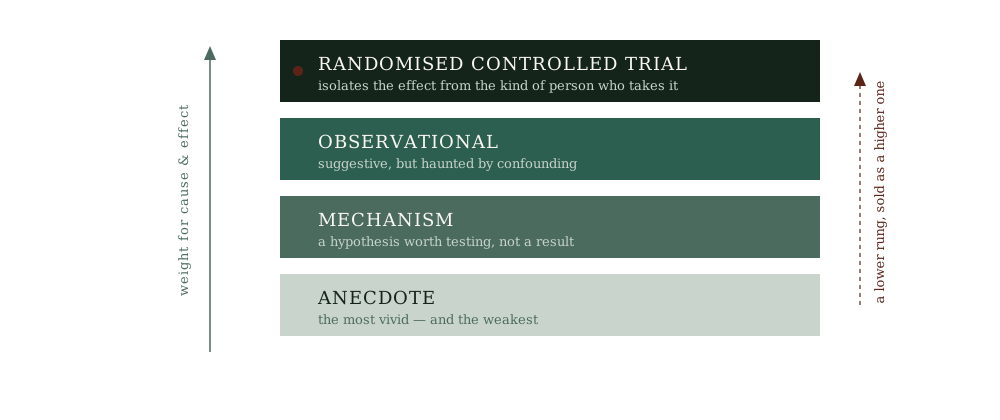
Not all evidence is the same weight, and the single most common move in supplement marketing is to present a light kind as if it were a heavy one. So the first question is simply: what tier of evidence is actually behind this claim?
At the bottom is the anecdote — the testimonial, the before-and-after, the story of the one person who got better. It feels like the strongest evidence because it is the most vivid, and it is in fact the weakest, because the person who got better while taking something may have got better for a hundred other reasons, and the people who took the same thing and did not improve are not in the advertisement. Above the anecdote sits mechanism — the laboratory story of how a substance could work, often demonstrated in cells in a dish. This is genuinely more than nothing: it generates a hypothesis worth testing. But a mechanism is a reason to run the experiment, not the result of the experiment. Above mechanism sits observational data — studies that follow populations and find that people who consume more of something have less of some disease. This is suggestive and it is where a great many supplement claims are born, but it is haunted by confounding: the people who take vitamin D are also the people who go outside, exercise, and can afford supplements, and any of those might be doing the work. At the top, for questions of cause and effect, sits the randomised controlled trial — where you take similar people, give half the substance and half a placebo, and watch what happens — because randomisation is the only tool that reliably separates the effect of the thing from the effect of the kind of person who takes the thing. Medicine has a formal framework for weighing evidence like this — it is called GRADE. You do not need its details. You need its instinct: ask which rung the claim is standing on, and notice when a lower rung is being described in the language of a higher one — a test-tube result called “proven,” a testimonial called “results.”
Question two: an outcome, or a surrogate?
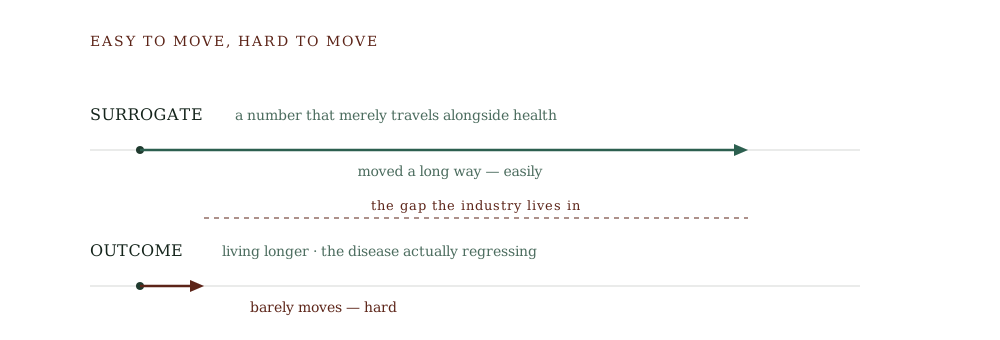
The second question is quieter and catches more claims than the first. When the supplement is said to improve something, is that something an outcome that actually matters to you — you live longer, the disease regresses, a symptom measurably lifts — or is it a surrogate, a number that merely travels alongside health without being it?
The distinction matters because surrogates are easy to move and outcomes are hard, and a great deal of the supplement industry lives in the gap between them. A substance can raise your blood level of an antioxidant, lower a marker of inflammation, or improve a number on a test, and none of that is the same as making you healthier, because the marker was only ever a stand-in for health, and stand-ins can be moved without moving the thing they stand for. When a claim tells you a supplement “improves” a biomarker, the honest next question is whether anyone has shown that moving that biomarker with that supplement moves an outcome you would actually notice. Very often the answer is that no one has, and the biomarker is being sold to you as though it were the health it was supposed to predict.
The cautionary tale that should frighten anyone selling a mechanism
Here is the story every person in my field should have to recite before they are allowed to recommend anything, because it is the story of how mechanism and surrogate — the two kinds of evidence natural medicine finds most seductive — pointed confidently in exactly the wrong direction.
Beta-carotene is the pigment that makes carrots orange, and by the 1980s it had as good a story as any supplement has ever had. The mechanism was elegant: it is an antioxidant, and oxidative damage was understood to contribute to cancer, so neutralising it should protect. The observational data was glowing: people who ate more beta-carotene-rich food had less lung cancer. The surrogate markers cooperated. Every tier of evidence below the randomised trial agreed that beta-carotene should prevent cancer. So the trials were run — large, careful, randomised trials in people at high risk. And in the CARET trial, published in 1996, the intervention group — given beta-carotene, with vitamin A — did not get less lung cancer. They got more — roughly a quarter more lung cancer, and more death — and the trial was stopped early because it was harming the people in it. A companion trial in male smokers (ATBC) had found the same two years earlier, and a later analysis pooling the antioxidant trials found that beta-carotene, along with vitamin A and vitamin E, was associated with higher overall mortality.
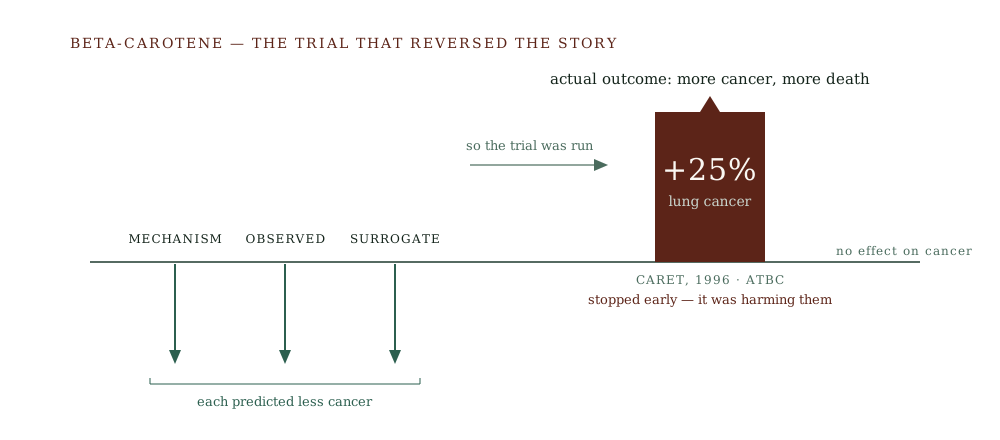
Sit with what that means. The mechanism was real. The observational signal was real. The surrogates moved the right way. And the outcome — the only thing that actually mattered — was the opposite of everything the lower tiers had promised. This is not an argument against evidence. It is the strongest possible argument for insisting on the right tier of it, and it is aimed squarely at my own field, because “it is an antioxidant, and antioxidants are good” is precisely the kind of clean mechanistic story that sells supplements and, in this case, killed people. Mechanism is a hypothesis. It is not a result. Anyone who forgets that, in either direction, is one well-told mechanism away from being confidently wrong.
Question three: what does the marketing structure betray?
The third question does not require you to evaluate any science at all, because it reads the shape of the selling rather than the substance of the claim — and the shape of the selling is often the most honest thing on the label.
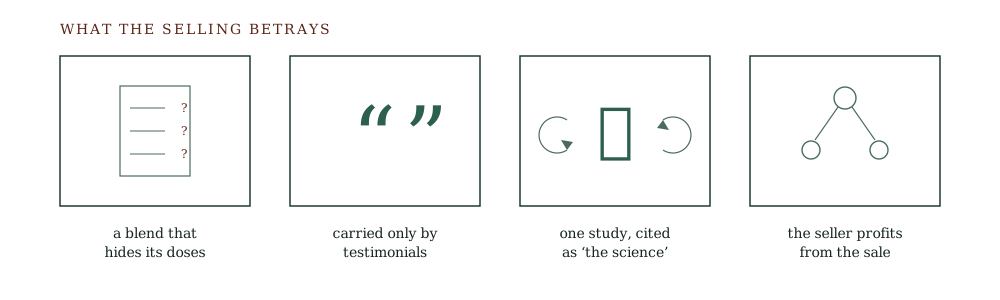
Certain structures reliably signal the absence of the data that would make them unnecessary. A proprietary blend that lists ingredients but hides their doses is concealing the one thing you would need to know whether any of them is present in a meaningful amount; a company with the evidence would show you the numbers. A claim carried entirely by testimonials is telling you it has no better evidence than testimonials, because a company with a trial would lead with the trial. A single dramatic laboratory study, cited over and over as “the science,” usually means there is a single study — and often that the substance dazzles in a test tube and does nothing in a body. Curcumin, the active compound in turmeric, is the textbook case: it is chemically the kind of molecule that lights up almost any laboratory assay it touches while being so poorly absorbed and so unstable that its spectacular in-vitro results have never translated into a single convincing clinical result, across more than a hundred trials. And the direct-selling structure itself — where the person recommending the supplement earns from your purchase and from recruiting other sellers — builds a machine whose incentive is the sale, not the evidence, and no amount of sincerity in the individual seller changes what the machine is optimised for.
There is a regulatory tell worth learning too. Almost everywhere, supplements clear a far lower bar than medicines: a drug must prove it works before it is sold, while a supplement generally need not. How that shows up on the label varies by country. In the United States, most explicitly, the labels perform a peculiar dance — claiming to “support,” “promote,” or “maintain” some function while a disclaimer in small print states that the product is not intended to diagnose, treat, cure, or prevent any disease and that its claims have not been evaluated the way a drug’s would be. Where you are, the wording differs, but the underlying fact does not: a registration number records that a product was allowed onto the shelf, not that it was shown to work. That distinction is worth knowing before you buy something to treat something — because the label is often telling you, in the only language the law permits, that no claim to actually treat anything could be substantiated.
Turning the checklist on my own shelf
Now the part that matters, because everything above can be used dishonestly — as a weapon to demolish other people’s supplements while waving your own through. A grifter can recite this entire method and apply it only to competitors. The single move that separates honest evidence-reading from that performance is the one a grifter never makes: running the checklist on the things you sell or recommend yourself, out loud, and reporting what it says even when the answer is inconvenient.
So: much of what I recommend does not sit at the top of the evidence ladder, and I will not pretend otherwise. A good deal of nutritional medicine operates on mechanism plus clinical observation plus a reasonable safety margin — a substance with a plausible and well-characterised way of working, a body of observational and practice-based experience suggesting benefit, and a low risk of harm — rather than on a stack of large randomised trials. You will notice that this is the same tripod beta-carotene stood on, and you should. That is exactly why the safety leg has to bear more weight than the other two: it has to mean established human safety at the dose I actually use — long, real-world use at that dose without harm — and never a mechanism’s promise that a thing ought to be safe. The moment a substance’s safety rests only on how clean its mechanism looks, CARET is the outcome I am obliged to treat as possible. I recommend from that tier, and I think it is defensible to do so — but only if I say plainly that that is the tier it is, and only where the safety leg is genuinely load-bearing. It is not the same as an RCT-proven drug, and telling a patient it is would be exactly the move I am warning you against. What I do not do is recommend from the tier below that — the substances whose support is essentially marketing, whose mechanism is speculative, whose safety is unestablished — however natural they are, and however well they would sell.
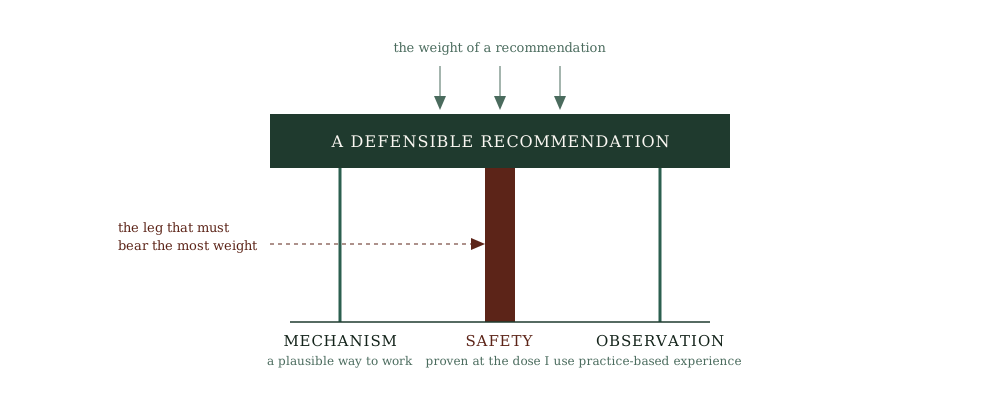
Two disciplines keep that honest, and they cut in opposite directions, which is how you know they are doing work. The first: unproven is not disproven. The absence of a large trial is not evidence that something does not work — most nutritional interventions will never have a pharmaceutical sponsor to fund the trial that would settle it, a gap I have written about elsewhere — so I do not get to dismiss everything that lacks an RCT, and neither should you, or the method collapses into a cynicism that throws out real signal along with noise. The second, pulling the other way: moderate evidence must be called moderate. I do not get to promote a mechanism-plus-observation substance in the language of proof simply because I believe in it, because the belief is precisely the thing the method exists to check. Hold both and you have the discipline. Drop either and you have a grifter — one who trusts nothing, or one who trusts everything he sells.
What would change my mind
The method I have described rests on a claim about evidence: that the higher tiers are more reliable guides to cause and effect than the lower ones. That claim is itself falsifiable, and worth saying how.
If it turned out that, for nutritional interventions specifically, the randomised controlled trial systematically misled — that its design reliably produced false negatives for this class of substance, so that things which genuinely work kept failing trials for structural rather than real reasons — then “did it pass an RCT?” would be a worse question than I have made it out to be, and the hierarchy would need reweighting for this domain. This is not a fringe worry; it is a live methodological argument about whether trials built for single-agent drugs can evaluate individualised, multi-component nutritional protocols, and I take it seriously. But it is an argument for interpreting the tiers with care, not for abandoning them — and crucially, it cuts against my own recommendations as much as anyone’s. If a substance I recommend were put through a well-designed trial suited to what it actually does and failed, the honest response would be to stop recommending it — and I do not get to keep redefining a “fair” trial every time one comes back null. One arguable mismatch is a reason to look again. A pattern of well-run failures is a reason to stop, and I would owe you that.
A closing argument
You will never out-read the marketing by reading more of it. There is always another claim, another testimonial, another study waved from a stage. What you can do instead is carry three questions and ask them of everything, evenly: what tier of evidence is this actually standing on; is it moving an outcome that matters or a surrogate that merely travels alongside one; and what does the structure of the selling — the hidden doses, the testimonials, the lone dazzling study, the disclaimer in the small print — betray about the data that is not there. None of the three requires a degree. All three require only that you be as willing to aim them at what you hope is true as at what you suspect is false.
That evenness is the whole of it. The reason the method is a real defence and not just another opinion is that it can be turned on its user, and the reason I can hand it to you honestly is that I have turned it on myself — conceding where my own recommendations sit, refusing the tier below, and marking the difference between what is proven and what is merely reasonable. The people you should trust least are not the ones who admit their evidence is moderate. They are the ones whose evidence is always, conveniently, overwhelming — and who have never once, in public, run the checklist on their own shelf.