Fermented is a useful food word. It is not a treatment plan.
Miso can bring a savoury note to a bowl of soup. Tempeh can give dinner a different texture. You can enjoy those foods without asking them to rebuild your gut.
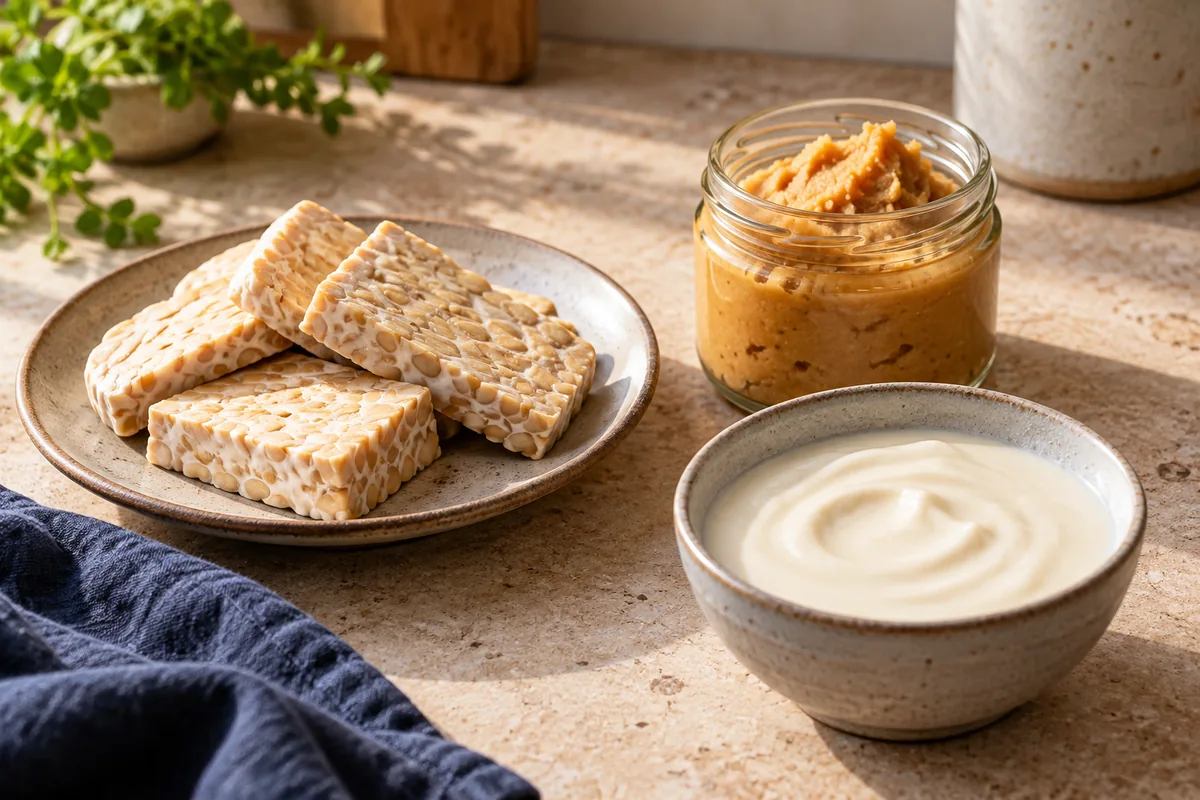
Miso can bring a savoury note to a bowl of soup. Tempeh can give dinner a different texture. You can enjoy those foods without asking them to rebuild your gut.
The word fermented tells you something about how a food was made. It does not, by itself, establish a specific health effect.
Three terms worth separating
Fermentation uses microorganisms during food production. Some finished foods still contain live cultures; others do not.
Probiotics refer to particular live microorganisms with demonstrated benefits when consumed in adequate amounts. Not every fermented food meets that description. Prebiotics are different again: food components used by microorganisms, rather than another name for helpful bacteria. NIH guidance makes these distinctions. [1]
Bring it back to dinner
If you like tempeh, prepare it according to its packet and serve it with vegetables and rice. If you like miso, use it for flavour in a soup you already make, following its storage instructions. These are serving suggestions, not tested recipes or probiotic prescriptions.
A small dietary study found changes in microbial diversity and inflammatory markers with a high-fermented-food diet. Those findings are interesting, but they do not prove that one fermented ingredient treats a digestive disease. [2]
You do not need to eat every food on a gut-health list. Nor should discomfort become something to push through because a food has a healthy reputation.
Choose a food you enjoy and tolerate. Keep any claim about treating symptoms as a separate question.
Sources, evidence and limits
Evidence basis: NIH ODS definitions and food-source sections reviewed. Wastyk et al. 2021 abstract plus accessible Methods/Results excerpts inspected: exploratory study, 36 analyzed; two participants were assigned to the fibre arm by request rather than randomized. Not a full-paper or supplement appraisal.
Least certain: Product-specific live organisms, dose, individual response and clinical relevance of biomarker changes.
Contrary evidence and context: The fermented-food study offers positive biological signals, but these were biomarker findings in generally healthy adults. Small size, partly nonrandom allocation and lack of clinical treatment outcomes limit inference; product-specific probiotic benefits cannot be generalized.
What would change the conclusion: Product-specific human outcome studies, individual restrictions or clinical advice could change use. A fermentation label alone remains insufficient to infer a treatment effect.
Reading behind this piece
- NIH ODS — Probiotics (definitions and food sources reviewed)
- Wastyk et al., 2021 — diet, microbiome and immune markers (abstract and selected sections reviewed)
Topic inspiration: 5 Rules for Optimal Gut Health, A Holistic Nutritionist Explains — Kristin Dahl, 2016-05-31. Full archived article body read, including the ending; not a newsletter-only reading.
Original wording for Everyday. A focused evidence check, not a systematic review.