There is a conversation that happens in clinic almost every week. A patient brings in the supplements they have been taking. The bottles are expensive. The labels look professional. The names are familiar from advertisements, from family recommendations, from social media. Many of them are American. Some are Taiwanese, Japanese, Australian. The patient wants to know if these are the right products to continue with.
The honest answer, often, is that they are not. Not because the patient was careless. Not because the brands are necessarily bad. But because there is a category distinction the public has never been taught, and the supplement on the pharmacy shelf and the supplement in the clinic are in many cases not the same product, even when the molecule on the label is identical.
The earlier articles in this series have argued that the dose on the bottle was rarely calibrated to physiology. This article argues something narrower and more practical: that the product itself — the formulation, the grade of raw material, the manufacturing standard, the design philosophy behind it — varies enormously across what looks, on the shelf, like a single category of supplements. And the variation matters more than most consumers have ever been told.
This is not a sales piece. It will name no brands, recommend no products, and dismiss no countries. It will, however, draw a line that the public has been carefully kept from seeing.
The country-of-origin myth
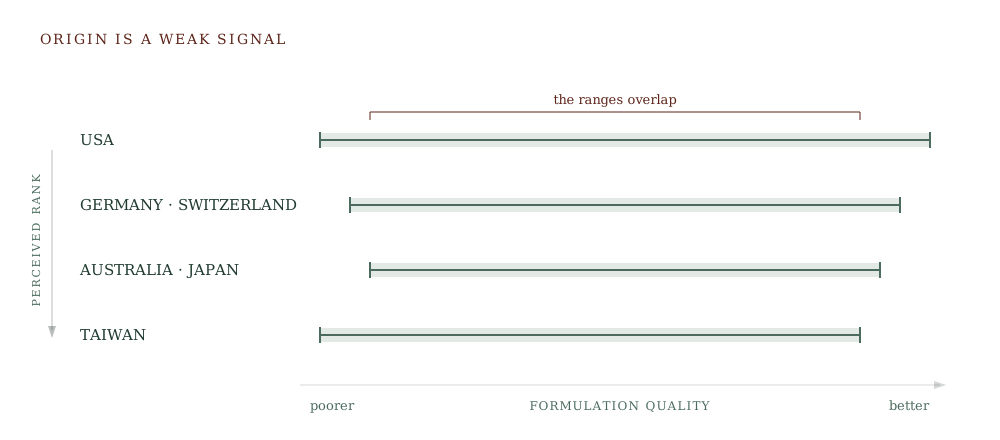
Walk into almost any pharmacy in Asia and you will see a clear pattern in how the public ranks supplements. American products sit at the top of the perceived hierarchy. Then European, particularly German and Swiss. Then Australian and Japanese. Then everything else. The assumption is that American manufacturing standards, American research, and American regulatory rigour produce a superior product, and that buying American is buying the best.
This belief is so widespread that it shapes purchasing decisions in homes, in clinics, and in the corporate gifting culture of the region. It is also wrong as a general claim, in ways the public has not been helped to understand.
A few facts that complicate the assumption.
The American supplement market is one of the most loosely regulated in the developed world. The 1994 Dietary Supplement Health and Education Act in the United States classifies supplements as food rather than drugs, which means they do not require pre-market approval, do not need to demonstrate efficacy before sale, and are inspected on the manufacturing side under standards that are real but variable in enforcement. Independent quality testing has, over the past two decades, repeatedly documented label inaccuracy, identity failures, and contamination issues across mainstream American consumer brands. Mainstream venues have published these findings — Consumer Reports, JAMA-published studies on supplement quality, the New York Attorney General’s 2015 herbal supplement investigation, and ConsumerLab’s ongoing testing programme. The American shelf contains some excellent products. It also contains some genuinely poor ones. Country of origin alone cannot tell you which is which.
The same is true of every other country the public ranks highly. German manufacturing has produced exceptional pharmaceutical-grade nutraceuticals; it has also produced ordinary consumer products with ordinary results. Australian manufacturing standards under the TGA are strict on paper, less strict in some product categories than they appear. Japanese supplements are often very high quality and equally often ordinary mass-market formulations dressed up for export. Swiss manufacturing has a justified reputation for precision in some product classes and is unremarkable in others.
And then there are the markets the public ranks lower. Taiwan, for example, has a notoriously saturated pseudo-nutraceutical market — products with elaborate claims, attractive packaging, weak formulation science, and minimal clinical validation. The same country also produces some genuinely sophisticated practitioner-channel products built to high pharmaceutical standards. The shelf next to the shelf can contain two products of completely different category, with no signal on the packaging that would help an ordinary consumer tell the difference.
Country of origin, in other words, is at most a weak signal of quality. It is not the signal you should be using. The signal that actually matters is whether the product was designed for clinical use or for retail performance — and that signal is rarely visible from the front of the bottle.
Two completely different design briefs
The clearest way to see the category distinction is to ask a simple question: what is this product trying to optimise for?
A general-retail supplement and a professional-channel supplement are answering very different versions of that question. The molecules on the label may be identical. The design briefs behind the products are not.
A general-retail supplement is optimising for a stack of variables that have very little to do with clinical outcome. It must survive long shelf life under variable storage conditions. It must hit a price point that allows distribution through pharmacies, supermarkets, and online marketplaces with their associated margins. It must look attractive on a shelf next to competing products. It must pass minimum regulatory thresholds for the markets it sells into. It must be palatable, swallowable, and appealing to a mass audience whose buying decisions are made in seconds.
These are not unreasonable goals. They are simply not the same goals as therapeutic effectiveness. A formulation designed to optimise for shelf life and price point will tend to use cheaper, more stable, less bioavailable forms of nutrients. A formulation designed to be sold without practitioner involvement will tend to use lower doses, because higher doses raise regulatory and consumer concerns the brand cannot address one-on-one. A formulation designed to compete on price will tend to use excipients, fillers, and binders that serve manufacturing efficiency rather than clinical performance.
A professional-channel supplement is optimising for a different stack. It must produce measurable clinical outcomes in patients under supervision. It must use raw materials of pharmaceutical grade, not food grade. It must use bioavailable forms — methylfolate rather than folic acid, methylcobalamin rather than cyanocobalamin, magnesium glycinate rather than magnesium oxide, vitamin K2 as MK-7 rather than synthetic K1, where the difference matters clinically. It must be tested for identity, potency, and contamination at standards more stringent than what general-market regulation requires. It must be formulated at therapeutic dose, because the practitioner who prescribes it expects it to do clinical work and will hear directly from the patient if it does not.
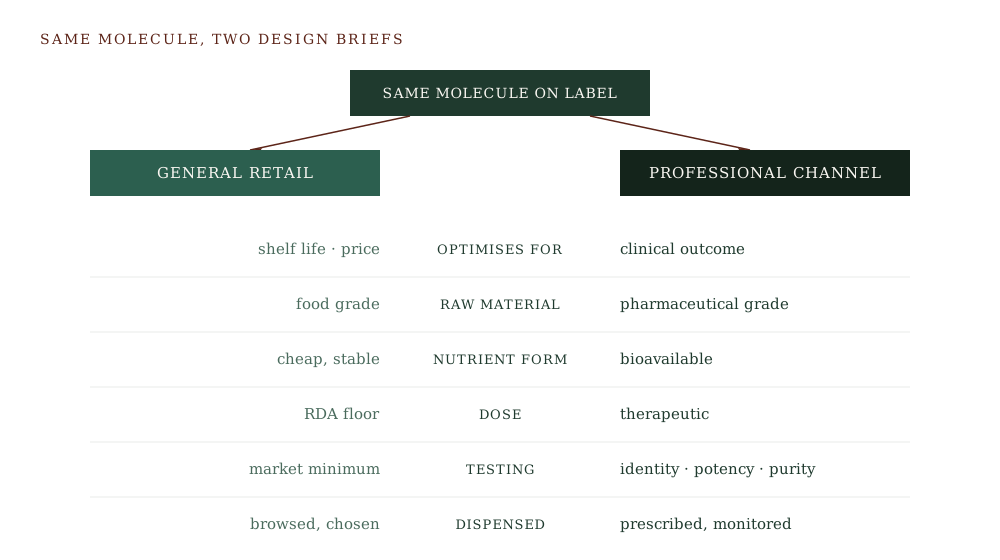
The difference between these two design briefs accumulates across every dimension of the product. Same molecule on the label. Different raw material grade. Different bioavailable form. Different dose. Different excipient profile. Different testing rigour. Different intended use. The price difference between the two products is rarely the largest difference between them, even though it is often the only difference the consumer notices.
Who designs each kind of product
The structural reason these two product categories exist as separate categories is that they are designed by different people, working under different incentives, for different end users.
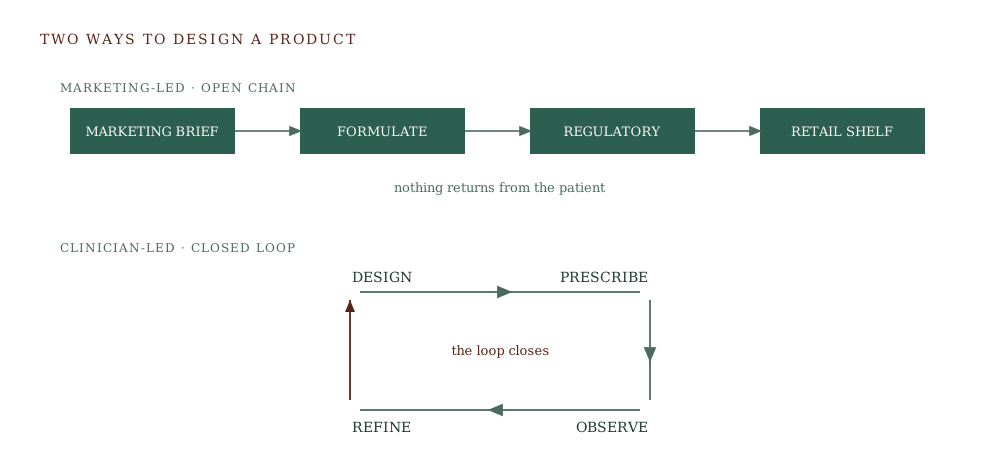
A general-retail supplement is typically designed by a formulation team within a manufacturing company, working to a brief from a marketing department, advised by regulatory consultants, and reviewed by a scientific advisor whose role is often validation rather than design. The formulation reflects what will sell, what will survive the supply chain, what will pass regulatory review, and what will hit the price point the marketing department has set. There is nothing dishonest about this process; it is simply what it is. The product is a consumer good that happens to contain a nutrient.
A professional-channel supplement is typically designed by a clinician, or by a small team that includes practising clinicians who use the product in their own patient practice. The formulation reflects what works at therapeutic dose, in actual patients, with feedback loops between clinical outcome and product iteration. The clinician knows what dose actually produces a measurable change in a deficient patient. The clinician knows which form of a nutrient absorbs in a patient with compromised gut function and which does not. The clinician knows what cofactors must be present for the headline nutrient to work. The product reflects this accumulated clinical knowledge in ways that a marketing-led formulation cannot replicate, because the design intent is fundamentally different.
This is the place to be precise about what therapeutic-grade product design actually requires, because the public claim ‘designed by experts’ is made by almost every supplement on the market, and the meaning of expertise varies enormously across product categories.
Designing a therapeutic-grade nutraceutical formulation requires fluency across several distinct domains. It requires biochemistry — understanding how nutrients are absorbed, transported, metabolised, and cleared, and how genetic and gut variation affects each step. It requires clinical pharmacology — understanding dose-response relationships, drug interactions, contraindications, and how nutrients behave at therapeutic dose rather than at survival dose. It requires manufacturing chemistry — understanding raw material sourcing, excipient compatibility, stability under storage, and contamination control. It requires clinical experience — knowing what actually works in patients across the spectrum of conditions the product is designed for, which is information that does not come from textbooks. And it requires the iterative discipline of using the product in clinic, observing what works and what does not, and refining the formulation accordingly.
This combined fluency is rare. It is not a profile produced by any single training pathway in nutritional health. It is built over time by clinicians who treat patients, observe outcomes, study the underlying biochemistry, and engage with formulation as part of their actual practice — not as a credential to print on a label.
This matters because the supplement market contains many products advertised as designed by qualified professionals, where the qualification involved has been adjacent to therapeutic-grade formulation rather than central to it. There are dietitians and nutritionists doing excellent clinical work in their own scope, and a small number who have built genuine therapeutic-formulation expertise on top of their training; this article does not dismiss them. But the broader pattern in the consumer supplement industry is that professional credentials get used as marketing signals rather than as evidence of formulation depth, and the public cannot tell the difference from packaging.
The defining marker of a serious professional-channel product is structural rather than aesthetic. The clinician designing the product is also using it, daily, on the patients they are clinically responsible for. The feedback loop is short, direct, and consequential. The formulation evolves in response to what actually happens in clinic. This is what therapeutic-grade design looks like in practice. It is not what most products on the public shelf were designed under, regardless of what the front of the bottle says.
A brief note on the brands that market themselves as professional
A category of brands sits between general retail and genuine professional-channel, marketing themselves as clinical-grade or doctor-formulated while distributing through consumer channels — most commonly through multi-level marketing networks, but also through direct-to-consumer online sales positioned as exclusive.
These brands occupy a useful space for their distributors and a confusing space for the public. The marketing language borrows the credibility cues of professional-channel formulation without operating under the structural conditions that make professional-channel formulation rigorous. The products are sometimes formulated by clinicians, but the clinicians have often signed on as advisors rather than as the practising users of the formulation. The distribution model is built on monthly repurchase by consumers rather than on prescription by practitioners. The dose, formulation, and price reflect mass-market economics rather than therapeutic intent.
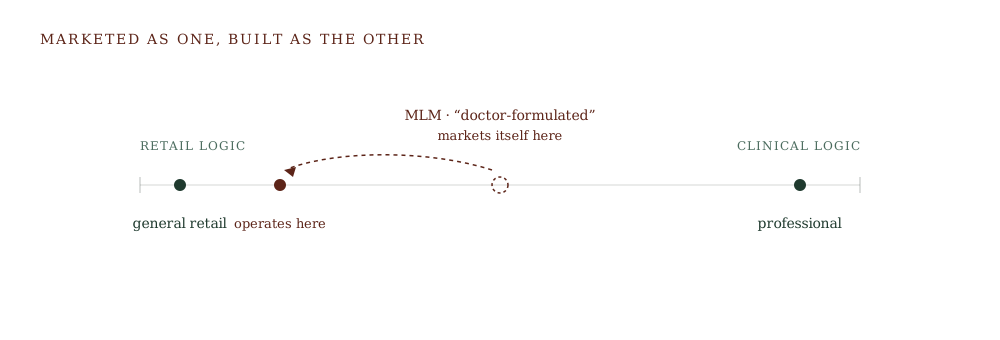
None of this means the products are necessarily harmful or that every such brand fails the same way. Some are genuinely well-formulated. Most are designed to extract margin from a distribution network rather than to produce clinical outcomes. The structural test is the same one that distinguishes general-retail from professional-channel: where is the product distributed, who actually uses it in patient practice, and is the design feedback loop short enough that the formulation evolves with clinical experience? Marketing language alone cannot answer this question. Distribution channel and clinical use can.
Why this matters at Tier 3 and Tier 4
For a patient operating at Tier 1 — taking a daily multivitamin as basic insurance against deficiency — the differences between general-retail and professional-channel are real but not large enough to change the clinical picture. A reasonable mass-market multivitamin, taken consistently, will deliver Tier 1 outcomes adequately. The category distinction matters less at this tier because the clinical demand on the product is small.
At Tier 3 and Tier 4, the category distinction begins to matter enormously.
A patient trying to optimise function — Tier 3 — needs nutrients in their bioavailable forms, at doses sufficient to produce measurable shifts in biomarkers and clinical experience, with cofactors present at the right ratios. A general-retail product that uses cheap, less bioavailable nutrient forms at Tier 1 doses will not deliver Tier 3 outcomes regardless of how consistently the patient takes it. The patient will conclude, often correctly, that supplements do not work — without realising they were taking a product engineered for a different clinical question.
A patient operating at Tier 4 — therapeutic protocols for established or complex clinical conditions — needs products formulated at pharmacological grade, with verified identity, verified potency, contamination testing at standards general retail does not require, and forms of nutrients that have been chosen for clinical effectiveness rather than shelf-life optimisation. The product is part of the protocol. Substituting a general-retail equivalent because the molecule on the label looks similar can compromise the entire clinical strategy. The clinician designing a Tier 4 protocol is not specifying the brand out of preference. They are specifying the brand because the protocol depends on what is actually in the bottle.
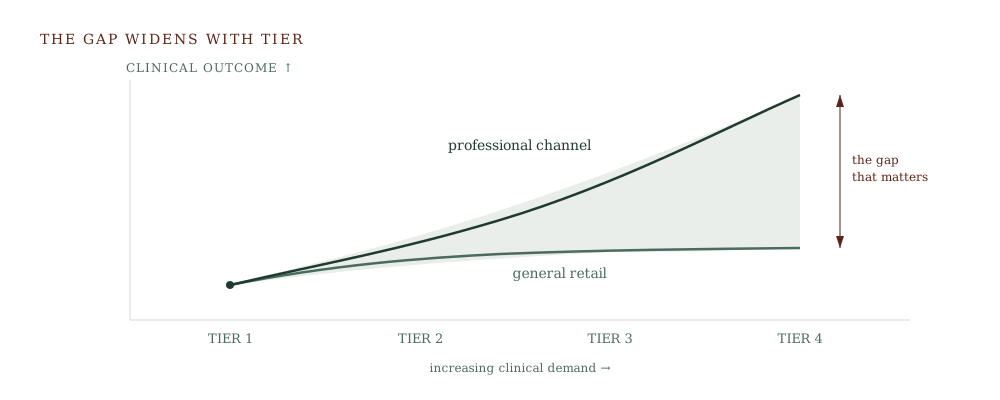
This is the practical reason that serious nutritional therapy operates through clinical channels. Not because clinicians are gatekeeping for commercial reasons. Because the products that produce Tier 3 and Tier 4 outcomes are, by their design, distributed through clinical channels — they are formulated to be prescribed and monitored, not browsed and chosen, and most are not available outside professional distribution.
A closing argument
The supplement industry has trained the public to evaluate products on the wrong axes. Brand recognition. Country of origin. Marketing language. Price as a proxy for quality. Familiar advertising. Family recommendation. None of these signals reliably tracks clinical effectiveness, because none of them describes what the product was actually designed to do.
The signal that does track is harder to see from the shelf. It is the design brief. It is whether the product was built to survive a supply chain or to produce a clinical outcome. It is whether the formulation reflects the constraints of mass-market economics or the requirements of therapeutic dose, bioavailable form, and cofactor balance. It is whether the people who designed the product are also the people who use it in patient practice and depend on it to work.
This is not a critique of the consumer supplement industry as a whole. The industry serves a real role at Tier 1 and a partial role at Tier 2, and the products it sells are reasonable for those purposes. The critique is that the public has been allowed — and in many cases actively encouraged — to assume that those products will deliver Tier 3 and Tier 4 outcomes, and that the bottle on the pharmacy shelf is functionally equivalent to the bottle in the clinic. Neither is true. The products were designed to do different things, by different people, under different incentives, for different patients.
If you are operating at Tier 3 or Tier 4 — trying to optimise function, or trying to reverse a clinical condition — the products that will actually produce those outcomes are largely not available in the channels you have been shopping in. They are distributed through clinical settings because they are designed to be prescribed and monitored, not browsed and chosen. This is not a marketing inconvenience. It is a structural feature of how serious nutritional therapy is delivered.
The conversation worth having, again, is with a clinician trained in nutritional and functional medicine — someone who can match the protocol to your physiology, the products to the protocol, and the monitoring to the products. The pharmacy shelf cannot do this work. It was never designed to.